
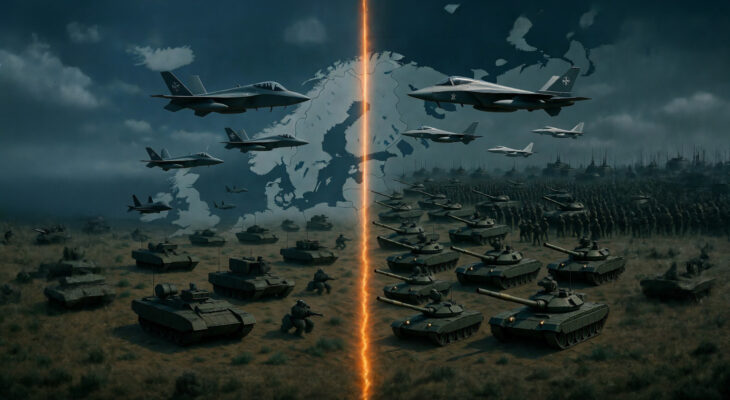
The Russia-Ukraine conflict remains locked in a brutal war of attrition centered on the Donbas region, with neither side achieving decisive breakthroughs as yet. Russian forces, now exceeding one million well-equipped troops after a methodical buildup, hold the initiative on the ground but continue with only cautious advances. Ukrainian long-range drone and missile strikes have intensified, targeting Russian oil refineries, Crimean infrastructure, and air bases, while Russia responds with large-scale barrages hitting Ukrainian cities and energy systems. Recent nights have seen hundreds of drones and dozens of missiles exchanged, raising civilian death tolls on both sides without actually shifting the front-line stalemate.
Key Military Developments
- Russian Position: Moscow has insulated its economy against prolonged Western sanctions and tested over a thousand new systems (drones, robotics, etc.) in combat. There’s increasing public and military frustration with the slow pace of progress, yet President Putin maintains restraint to avoid broader NATO entanglement in western Ukraine. Analysts describe a “Rubicon” moment where decisive options exist but escalation risks are weighed heavily against them.
- Ukrainian Campaign: Kyiv’s deep strikes aim to disrupt Russian logistics and war economy, including recent hits on facilities near Moscow and in occupied Crimea. Russia is countering with upgraded jet-powered drones and volume fire. Both sides are locked in a rapid innovation race where temporary edges evaporate quickly.
- Civilian Impact: Ukrainian strikes have hit residential areas and infrastructure inside Russia; Russian responses have damaged Ukrainian urban centers. Reports and analysis confirm deliberate targeting patterns on both ends, contradicting sanitized media narratives of precision-only operations.
Europe and NATO: Rhetoric vs. Reality
European and NATO war-signaling has grown more explicit in recent months, with public statements framing preparation for direct confrontation against Russia and high-alert postures on the eastern flank. Finland’s move to host nuclear weapons and Russia’s consequent public warnings to the Baltic states (Estonia, Latvia, and Lithuania) exemplify this Euro-war-rhetoric approach. Yet European conventional forces remain limited in numbers and ill-supplied for prolonged conflict against the Russian military might.
Even the entirety of Europe’s armed forces combined is “boutique” in scale if deployed against Russia.
European rearmament timelines also stretch into the 2030s, while current weapons stocks are partially withheld for potential “big fight” scenarios in case of Russian attacks on EU nations.
This creates a dangerous mismatch: provocative posturing and enabling of Ukrainian deep strikes (via intelligence and technology) erode longstanding East/West red lines without the backup of the necessary military strength to deal with potential consequences or employing sufficient diplomatic guardrails to de-escalate. This ill-conceived strategy prolongs the Ukraine proxy conflict while grossly underestimating Russian resolve and historical sensitivity to threats on its borders. Claims of imminent Russian collapse or easy NATO dominance ignore Russia’s rapid, combat-tested evolution and Europe’s laughable logistical vulnerabilities. Winter warfare realities and infrastructure/supply-line dependence further expose the absurd power asymmetry should tensions spill over.
Likelihood of Direct Russia–Europe/NATO Conflict
Short-term (next 1–3 months): Low to moderate, with upward pressure. Intensifying drone exchanges and hybrid probes (sabotage, airspace incursions) seriously raise miscalculation risks that lead to conflict escalation, but both sides currently show calibrated restraint. A full conventional clash remains unlikely in the coming few months.
Medium-term (by end-2026 into 2027): Moderate to elevated. A prolonged stalemate, Ukrainian deep-strike pressure, and European rhetorical escalation could compel Russia toward faster battlefield decisions or expanded hybrid disruption. Absent negotiations acknowledging ground realities and Russian security concerns, the window for vertical or horizontal escalation widens. Direct NATO-Russia war stays improbable given the overall capability gaps and waning of American support, yet hybrid spillover (sabotage, cyber attacks, drone strikes, etc.) against European arms/tech manufacturers or signaling incidents (airspace incursions, military exercises close to borders, etc.) grow more plausible.
Strategic Implications
The conflict is a grinding proxy war with high escalation potential but contained within conventional boundaries, for now. Russia’s focus stays on Ukrainian objectives and force regeneration; Europe’s approach risks turning manageable friction into unnecessary direct confrontation. Diplomatic off-ramps remain absent, with recent US mediation efforts stalled by parallel crises in the Middle East.
Bottom line: Continued attrition favors the side with superior numbers and equipment: Russia.
Meanwhile Europe’s narrative of easy victory or controlled escalation ignores history and current military asymmetries. Whether this is because European leadership is acting out of ill-advised foolishness, or under the orders of a higher agenda (think NWO “economic regions” instead of nation states) remains questionable.
In a sane world, the EU should prioritize realistic negotiations over performative posturing. Yet that is not the case.
Hybrid escalation risks and long-range strike spikes will ongoing define developments through summer and fall; watch for Russian responses to sustained Ukrainian infrastructure attacks as the key near-term variable. Sabotage or drone strikes against Western drone/tech manufacturers are becoming increasingly likely.