
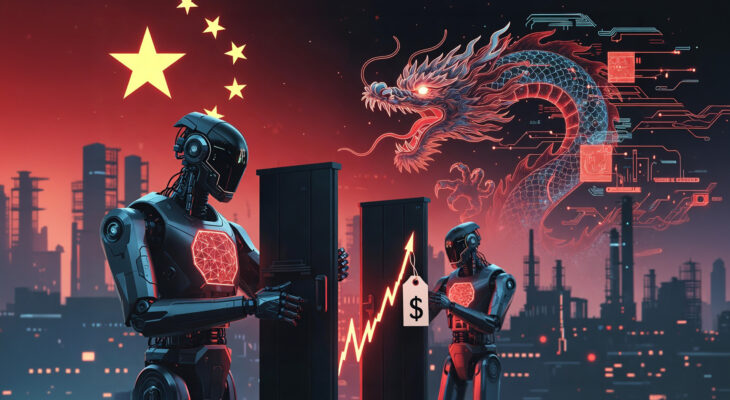
Right now multiple economic pressures are converging, creating a more difficult environment for ordinary households than official narratives are willing to even hint at. Among these, three developments stand out in particular:
- A weakening U.S. labor market
- The inflationary effects of massive artificial intelligence spending
- China’s steady advancement in the industries that will shape future economic power.
And while these trends are interconnected, each carries a separate, direct set of consequences for people trying to maintain financial stability and plan for the future.
Jump to Section:
- The Weakening Labor Market
- AI-Driven Inflation
- China’s Increasing Dominance
- How It Affects You
- What You Can Do
The U.S. Labor Market
The U.S. labor market has deteriorated FAR MORE than headline numbers revealed. Recent data showed only 57,000 jobs added in June, which is far below expectations. But more significantly, labor force participation has fallen to its lowest level since the height of COVID in early 2021.
Hundreds of thousands of working-age adults are not simply unemployed; they have left the workforce altogether. This matters because it not only reduces average household incomes today, but also reduces the total number of people producing goods and services, which directly lowers overall economic output and therefore weakens the GDP.
Further, many of the jobs being created now are concentrated in lower-paying sectors such as leisure, hospitality, and social services, while higher-quality employment in manufacturing, technology, and professional services faces ongoing pressure from automation, offshoring, and corporate cost-cutting. For normal families, this translates into ever-growing job insecurity, slower wage growth, and increased difficulty in building savings or planning for retirement. Young people entering the workforce are particularly affected, as they face both limited high-quality opportunities and rapidly inflating living costs.
AI as an Inflation Driver
At the same time, artificial intelligence is functioning as a source of inflation rather than one of immediate cost relief. The enormous capital spending on data centers, advanced chips, and the energy required to power them is driving up demand and costs for materials, electricity, specialized components, and especially rare earth minerals, most of which are controlled by China.
Federal Reserve discussions have begun acknowledging that AI-related investment is contributing to higher core goods prices. While AI may eventually improve productivity, those benefits are unlikely to arrive quickly enough to offset the current cost increases. For average households, this means higher prices for everyday goods and services at a time when wage growth remains uneven or even stalls. Energy costs, in particular, are likely to stay elevated as data center demand competes with existing industrial and residential needs. This creates a squeeze where living expenses rise far quicker than many people’s ability to keep up.
China’s Increasing Dominance
These domestic challenges are occurring alongside a clear shift in global economic momentum. China has methodically strengthened its position in electric vehicles, batteries, solar technology, advanced manufacturing, and increasingly in artificial intelligence applications. Its export performance in these sectors has remained strong even during periods of global uncertainty. One only needs to take a look at the flood of low-priced Chinese Electric Vehicles currently hitting Western markets, to get an idea of what we’re talking about.
This is not simply a story of lower labor costs. It reflects long-term industrial policy, control over critical supply chains, such as rare earth minerals, and sustained investment in the technologies expected to define the coming decades. For people in North America and Europe, this shift has real implications. It increases competitive pressure on Western industries, potentially leading to further job losses in manufacturing and technology sectors. It also suggests that future technological leadership, along with the high-value jobs that come with it, may increasingly reside outside Western economies.
How It Affects You
When these three trends interact, the effects on ordinary people rapidly become more pronounced. A weaker labor market reduces income security at the same time that AI-driven spending pushes certain everyday costs higher. Meanwhile, the relative rise of Chinese industrial and technological capability makes it harder for Western economies to generate broad-based prosperity through traditional channels.
The result is an environment in which asset prices can remain elevated while the underlying economic foundations supporting most households grow more fragile. Many families are already experiencing this through stagnant real wages, rising housing and energy costs, and growing uncertainty about long-term job prospects.
What You Can Do
In this environment, preparation matters more than optimism. Individuals can take several practical steps to improve their position. Reducing exposure to highly valued technology assets that depend on continued hype and easy capital can lower portfolio risk. Building holdings in real assets such as physical gold and silver provides a form of monetary insurance during periods of financial stress. Developing skills or secondary income sources that are less dependent on large corporate employment structures increases personal resilience. And finally, focusing on reducing high-interest debt and maintaining a stronger cash buffer helps protect against sudden income disruption or rising costs.
These pressures are permanently structural rather than temporary.
Understanding how they affect daily life is an important first step toward making better decisions about work, spending, and savings.
Want to know more about the available solutions?
You’ll soon be able to join us for deeper dives, member-only information, and greater detail/concrete examples about what you can do to stay prosperous in these uncertain times.