For decades, the international community has operated under a fragile assumption regarding Iran: the nation’s nuclear program remained a carefully managed ambiguity with Iran assumed to have advanced enrichment capabilities, but no actual weapon.
That assumption now appears to be obsolete.
Reports from multiple channels, including high-level backchannel communications, indicate that Tehran has achieved the ability to detonate a nuclear device and is prepared to demonstrate it openly if external pressures and threats from Israel and the USA continue.
This development has not appeared from nowhere. It follows repeated cycles of U.S.-Israeli military actions against Iranian targets throughout 2025 and into 2026, including attacks on nuclear sites like Natanz, Fordow, and Isfahan, leadership assassinations, and naval incidents in the Persian Gulf.
But despite being harried like this continuously, Iran has demonstrated remarkable resilience, rapidly restoring operations at damaged facilities and maintaining a solid proxy influence across the region.
The Breaking Point
According to well-placed diplomatic exchanges in late May 2026, Iranian President Masoud Pezeshkian conveyed a clear three-part message to Pakistani Prime Minister Shehbaz Sharif, using Pakistan to act as a key mediator for transmission to Washington:
- An immediate halt to ongoing conflicts in Lebanon and Gaza, including blockades.
- Prioritization of de-escalation and Strait of Hormuz stability before any nuclear discussions.
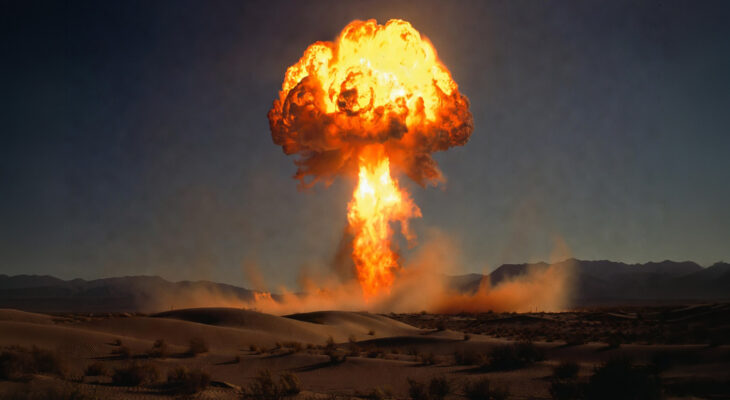
- A willingness to conduct a nuclear “demonstration” on Iranian soil… not as an offensive strike, but as an unambiguous signal of sovereign capability and escalation control.
This sequencing reflects deep frustration in Tehran: Repeated good-faith negotiation attempts, followed by surprise attacks, have eroded the Iranian leadership’s trust.
The shift under new Supreme Leader Mojtaba Khamenei appears driven by survival imperatives, overriding earlier theological reservations about the use of nuclear weapons. Iran’s scientific base, bolstered by decades of indigenous expertise and selective external technical inputs, has evidently closed the final gaps.
What’s more, public signals align with intelligence reports. Iran has suspended nuclear talks, escalated limited responses to recent U.S. strikes (including naval and airfield incidents,) and shown restraint that analysts interpret as calculated signaling rather than weakness.
President Trump’s notably more measured rhetoric in recent days, which contrasts sharply with earlier threats, also suggests Washington is treating the new information with gravity.
Corroboration Across the Board
Independent assessments reinforce the seriousness of this situation. U.S. intelligence had previously estimated Iran could assemble a weapon in months under certain conditions, even after 2025 strikes degraded facilities.
Underground hardening, dispersed stockpiles of enriched uranium, and concerted repair efforts have considerably narrowed these timelines again.
Access for the International Atomic Energy Agency (IAEA) still remains restricted, further heightening geopolitical uncertainties.
Pakistan’s central mediating role, longstanding technical ties in the region, and coordination with China provide structural backing for these developments.
All in all, the broader multipolar alignment (Russia, China, Iran, and Pakistan) has deepened under pressure during the U.S./Iran conflict, through energy corridors, military support, and diplomatic cover, thus further providing Tehran with additional strategic depth.
Why it ALL Marks a Genuine Change to the World Order
This is not business as usual!
For the first time since the Nuclear Non-Proliferation Treaty (NPT) framework took hold, a major regional power appears to be ready to move from atomic ambiguity to explicit demonstration of nuclear capabilities under pressure.
The implications ripple far beyond the Middle East:
- Deterrence Revolution: A nuclear-capable Iran fundamentally alters Israeli and U.S. military planning. Future strikes by an Israeli-controlled United States carry vastly higher risks of escalation. Multiple devices/responses on separate continents would amplify this effect dramatically.
- NPT Erosion: The treaty’s credibility, which is already strained, now faces a severe test. Other states (Saudi Arabia, Turkey, others) may accelerate hedging strategies to develop their own nuclear deterrents.
- Energy and Economic Shockwaves: Control over the Strait of Hormuz, through which 20% of global oil passes, becomes an even sharper lever for Iran.
Markets are already pricing in prospective volatility. A nuclear Iran will send that volatility off the charts.
- Multipolar Consolidation: This development strengthens the Russia-China-led axis, demonstrating that Western military pressure can accelerate, rather than prevent, proliferation among determined actors, thus rapidly eroding U.S. global military hegemony.
- U.S. Strategic Reckoning: For the Trump administration, it validates long-held skepticism of past deals while complicating “maximum pressure/eradication” approaches. Serious diplomacy, likely requiring Israeli restraint (difficult, considering the zionist master-race complex,) now becomes the least-bad option.
For those seeking clarity without daily deep dives:
This is a pivotal paradigm shift. The post-Cold War unipolar moment, already fading, has now lost another pillar.
Mutual deterrence, once confined to the great global powers of America and the Soviet Union, is expanding into critical global regions. Stability from here on in will depend on whether Washington (Trump,) Tehran, and Jerusalem (Netanyahu) can navigate toward a non-ego/agenda-driven sequenced de-escalation to end active conflicts first, secure maritime routes, then address the expanded nuclear file realistically.
The coming weeks will be defining.
A desert “demonstration,” renewed intense diplomacy via Pakistan/China channels, or further tit-for-tat strikes… any path from here will confirm that the old rules no longer fully apply.
The world order is adapting, whether policymakers and the media acknowledge it or not.
And once this news breaks publicly, the markets will take a pounding… Want to know what to do then? Look out for our deep-dive over the weekend…
But! Spoiler Alert! “Buy when there’s blood in the streets.