
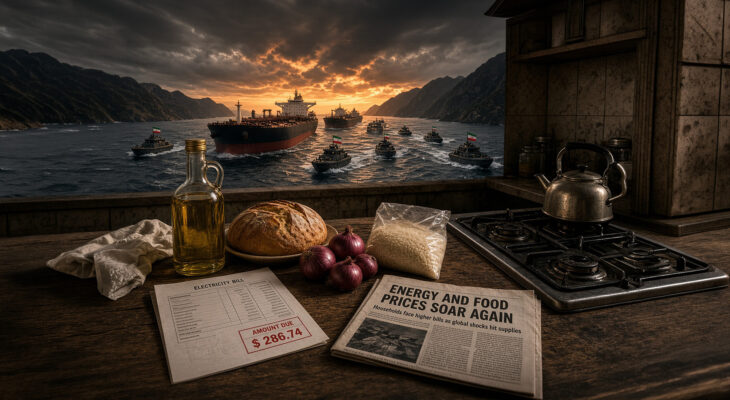
Strategic Exhaustion, Hormuz Control, and the Growing Costs for Households in North America and Europe.
Five months after the major escalation of the US-Israeli campaign against Iran, the war’s strategic balance has shifted massively. The United States and Israel are materially and operationally depleted. Iran holds the decisive advantage both in the wider conflict and, most importantly, over the Strait of Hormuz.
Unsurprisingly, regional powers are adjusting their security arrangements accordingly, and I’m sure that the Mecca Pact is only the first manifestation of a wider set of developments to come in West Asia.
One thing is certain, the consequences of this and further developments will not remain confined to the Persian Gulf or the Middle East; they will register in energy bills, grocery prices, and household budgets across North America and Europe.
Jump To Section:
- Evidence Of Strategic Exhaustion
- The Iranian Advantage
- What Consequences Should You Expect?
- Near, Medium & Long-Term Outlook
- Practical Steps For You
- Mission Failed…
The Evidence of Strategic Exhaustion
Official and military assessments now acknowledge what battlefield realities have long demonstrated for America. Critical long-range strike munitions have been largely expended. Israeli air-defense interceptor stocks are severely reduced. Rebuild timelines for critical inventory stretch into years, constrained by supply-chain dependencies that cannot be resolved overnight. The specialized planning staff that operates continuously during major active combat campaigns has also been stood down.
And of course, despite earlier viceral threats by Trump of automatic, severe retaliation for Iranian attacks on Hormuz shipping, no such responses have followed recent enforcement actions against non-compliant vessels.
In short, it’s becoming abundantly clear that America and Israel bit off more than they could chew when they attacked Iran back in February.
Let’s face it. We are now in month six of a conflict Trump claimed to have won after two days.
Gulf governments, most notably Saudi Arabia, have also intervened directly to discourage further major escalations, citing the risk of devastating Iranian counter-strikes against regional infrastructure. Israel, of course, continues to favor intensified pressure on Iran; key elements of the US military leadership most definitely do not.
Chairman of the Joint Chiefs Gen. Dan Caine has been conducting private consultations with senior administration figures to ensure a shared understanding of America’s strategic and logistical limits. He is actively seeking an off-ramp, warning that additional air campaigns are unlikely to alter Iranian behavior and that escalation carries high risk of regional blowback without achieving any core political objectives whatsoever.
Even a substantial new offensive, according to these assessments, would neither loosen Iranian control of Hormuz nor resolve the nuclear questions originally advanced as justification for the war.
Iranian Advantage at the Chokepoint
This conflict was never solely about nuclear capabilities; the Strait of Hormuz has always been its central focus. The war has been a contest over an energy artery and the financial architecture that historically accompanied it… and Iran has imposed practical control, despite American challenges or claims to the contrary.
Vessels seeking transit must submit detailed applications for approval. Unapproved traffic faces interdiction. Reports indicate that Iran has discussed imposing transit fees in the range of 5 to 7 percent on vessels using the Strait of Hormuz.
Full facilitation of Hormuz traffic also remains linked to broader Iranian conditions, including the lifting of naval restrictions, sanctions, and asset freezes.
These are not the actions and demands of a regime that’s been summarily defeated and depleted by America’s military might.
From where I’m standing two tracks forward are visible.
A technical arrangement between Iranian and Omani authorities is advancing that would place inbound traffic under comprehensive Iranian procedures and fees while applying layered oversight (a two-stage clearance process) for ships leaving the Persian Gulf.
In parallel, Iranian legislative bodies are considering more permanent formalization that would condition or restrict passage for vessels linked to the United States, Israel, and other designated “hostile” parties, potentially including compensation requirements.
Neither Israel nor the USA appear to possess any military instrument capable of changing Iran’s trajectory anytime soon. External powers, like Russia and China, who might otherwise exert leverage over Iran also show no indication of withdrawing support for Tehran’s position.
Let’s face another thing; By weakening U.S. power projection and depleting its critical munitions and credibility, Iran is accelerating the rise of Russia and China in the emerging multipolar order.
So here we are then…
What Consequences Can You Expect In Daily Life?
Energy markets have already begun to factor the new “Post-Hormuz” risk environment.
Sustained Iranian influence over Hormuz transit (whether through formal fees, selective restrictions, or persistent uncertainty) forces a higher baseline for oil prices. Higher crude costs translate directly into gasoline, diesel, heating fuel, and electricity prices.
Shipping and insurance costs for bulk commodities rise in parallel. Fertilizer production, which is highly energy-intensive, sees corresponding upward pressure.
And together these effects compound into food prices, manufacturing inputs, and the general cost of living.
In North America, there are few policy buffers remaining to absorb coming price spikes. Strategic Petroleum Reserve capacity, possible temporary fuel tax relief, and targeted subsidies have already been substantially drawn on and offer little room to act as further cushions.
In Europe, where energy security remains a hideously systemic structural vulnerability thanks to the regime’s “net-zero policy” insanity, the same dynamics massively increase import bills and industrial operating costs. Households, particularly those on fixed or semi-fixed social security or pension incomes (about 27.5% of the EU population,) feel the impact through higher utility costs, transportation expenses, and grocery receipts, even when the EU’s “official” inflation measures appear “well under control.”
Near, Medium, and Longer-Term Outlook
Near Term (coming weeks to three months)
A temporary technical arrangement governing Hormuz transit under Iranian conditions is the most probable development.
Oil prices will remain elevated relative to early-2025 levels, with intermittent volatility caused by enforcement incidents or diplomatic theater. Fuel, heating, and fertilizer costs will continue to stay under upward pressure. Retail food costs will inflate to reflect these increases.
Diplomatic talks will continue, but a comprehensive settlement that meets the main political demands of either side remains unlikely because of significant domestic political constraints in Washington.
Public “war fatigue” ahead of the midterms, depleted munitions, military resistance to further escalation, rising energy costs, and internal administration divisions have effectively backed Trump into a corner.
Perhaps I should say Trump’s hubris has backed him into that corner.
Medium Term (six to twenty-four months)
If Iranian gatekeeping becomes more institutionalized, energy risk premiums will settle into a higher structural range. Regional states will accelerate diversification of security partnerships to compensate for America’s rapidly diminishing presence and influence in the Middle East.
Oil and related commodity prices will remain well above pre-war levels. Rising fertilizer and logistics costs will translate to persistently higher baseline food prices. Already the bane of European industry, energy expenses will become an increasing obstacle to its products’ global competitiveness.
Israeli capacity for independent military operations will also be severely limited by the absence of American muscle in the region. Thank god for small mercies, eh?
Longer Term (beyond two to three years)
A more multipolar security and energy order will solidify.
Iranian influence over a critical transit artery, combined with reduced American reach, will contribute to gradual evolution in energy settlement practices. Chronic elevation of energy and logistics costs will become embedded in global price structures. Food systems still heavily reliant on Middle Eastern energy and fertilizer inputs will operate under a permanently higher cost environment. This, in turn will encourage diversification of production and supply chains at national levels.
For households in North America and Europe, this will become a durable component of living costs rather than a transitory shock, because Brussels is bound and determined to continue its current suicidal course of action, not just on net-zero carbon, but on food production restrictions and limitless mass-migration. But that topic is for another analysis…
Practical Steps for Household Resilience
The effects I’ve described above already show in your monthly expenses… and they will intensify.
However, a few measured adjustments can meaningfully reduce your exposure:
I would advise reviewing your household energy efficiency and, where practical, locking in utility or fuel arrangements at rates you consider acceptable. This is simpler in Europe than North America.
It is also wise to maintain larger cash or short-duration fixed-income reserves so you can cover essential expenses through periods of volatility without forced selling of tangible assets.
On the investment side, I would gradually reduce pure dependence on uninterrupted low-cost energy imports. Instead, I favor assets with pricing power or tangible backing (selected energy producers like Chevron, Shell, etc. commodity-linked instruments like ETFs or funds that track energy) and quality real assets in stable locations. I would certainly avoid concentrated speculation on anything that requires a rapid diplomatic breakthrough for the Hormuz standoff.
NOTE: Not financial advice, just, “you know,” educational…
At the household level, modest diversification of food sources, away from the mainstream and towards local producers, and a limited stockpile of non-perishable essentials will provide useful protection against temporary price spikes or supply chain breakdown caused by “logistical friction.“
For those with substantial portfolios, I recommend examining currency and geographic diversification with the help of a qualified advisor.
Personally I pay attention to official statements on Hormuz transit arrangements coming from Iran, as well as “U.S. Force Posture,” which is to say the overall size, positioning, readiness, and deployment of its military forces in the Middle East. This gives me a far better “early warning system” than consumer price data or mass-media narratives.
Mission Failed…
What began as an action against a “terror regime that wants nukes” has become a test of material endurance and control of a vital energy artery which the USA and Israel have objectively failed.
Iran without any doubt holds the far stronger position.
The reported preference of the Joint Chiefs for an off-ramp reflects the recognition of that stark reality… And with America’s role as the “World Police” diminished, the door is wide open for the new, multipolar order and a tokenized NWO global economy.
The prudent course for ordinary people is clear-eyed preparation for a period of higher and more persistent energy and food costs. It’s also a good idea to get some physical metals and other tangible assets into your possession.