Three of the Muslim world’s most consequential powers just formalized a collective security arrangement that quietly redraws the regional map. And while public attention remains firmly fixed on the grinding conflict with Iran and the almost daily Houthi escalations, this agreement marks a deeper structural shift. Turkey, Saudi Arabia, and Pakistan have chosen to bind themselves together under a mutual defense framework.
This is more than just political theater.
It is a calculated response to the limits of external American guarantees of stability, and a clear acknowledgment of the emerging reality of the multipolar order. The agreement itself is straightforward. Its implications are not.
Jump To Section:
- The Mecca Agreement
- Regional Implications
- Impact On Israeli Expansionism
- Hedging Against U.S. Unreliability
- A Step Towards Multipolarity
The Mecca Agreement Itself
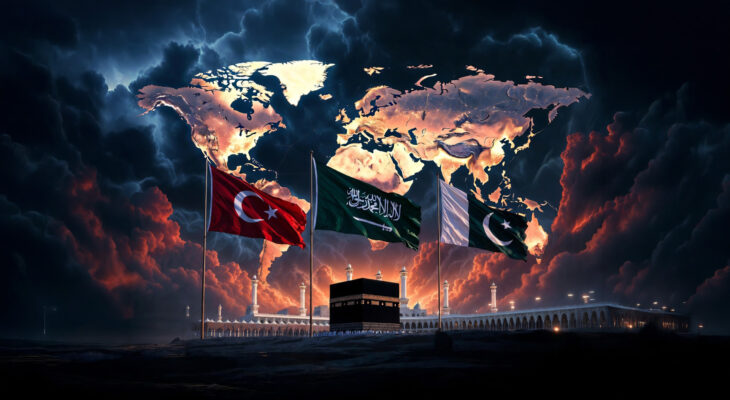
Three major Muslim powers formalized a collective defense pact today. Turkey, Saudi Arabia, and Pakistan signed the Mecca Joint Defence Agreement. The core clause is simple and deliberate: an armed attack on any one of them will be treated as an attack on all three.
The agreement was signed by Saudi Crown Prince Mohammed bin Salman, Turkish President Recep Tayyip Erdoğan, and Pakistani Prime Minister Shehbaz Sharif. It expands the 2025 Saudi-Pakistan bilateral mutual defense deal by adding Turkey’s conventional military weight and defense industry into the mix. Officials describe it as purely defensive, open to other regional states, and “not directed at any single country.” It also does not replace other existing arrangements, including Turkey’s NATO membership.
Each party brings distinct capabilities to this table:
- Saudi Arabia supplies capital, strategic depth, and Gulf energy leverage.
- Turkey contributes NATO-standard forces and a rapidly growing indigenous defense sector (especially drones and systems).
- Pakistan supplies large conventional forces and the only nuclear arsenal in the Muslim world.
Regional Implications
This is a major structural shift in Middle Eastern security architecture.
For years, Gulf states and others in the region leaned heavily on external guarantees by America. The Mecca Agreement creates a parallel layer of collective deterrence among three significant regional players. It raises the cost of aggression against any member significantly, and greatly reduces the ability of external actors to treat them as isolated targets.
In the current environment: the ongoing U.S.-Israeli conflict with Iran, Iranian-linked strikes on Saudi targets, and massively disrupted shipping of crucial resources, the agreement signals that these states intend to shape their own security outcomes rather than wait for third-party rescue.
Impact on Israeli Expansionist Ambitions
Israel’s freedom of unilateral military action in the Middle Eastern region now faces increased friction. A formal collective-defense framework that includes nuclear-armed Pakistan changes the Netanyahu regime’s risk calculations in a major way. Actions that escalate into direct conflict with a pact member now carry the theoretical risk of drawing in the others. Pakistan’s nuclear capability, even if not formally extended as an automatic umbrella, introduces a qualitative deterrent that did not previously exist in this regional configuration.
“Greater Israel”
Maximalist projects, whether framed in religious-nationalist terms or as long-term territorial and influence ambitions, depend on Israel’s sustained freedom to act with limited regional pushback and reliable external cover by America. A more cohesive Muslim security arrangement significantly reduces that operational freedom. It does not create an immediate anti-Israel war coalition, but it hardens the regional environment against unconstrained Israeli expansion.
In short, the old pattern of treating Arab and Muslim states as fragmented and externally dependent is eroding.
Hedging Against U.S. Unreliability
Make no mistake, this pact is a classic hedging move.
The three signatories are long-time or formal partners of the United States. They are reacting to a clear loss of confidence in Washington’s willingness or capacity to serve as a sole security guarantor within their respective sphere of influence/operations.
The U.S.-Israeli war on Iran and the resulting spillover attacks on Saudi territory exposed the limits of that guarantee. Regional capitals watched American political bandwidth, increasing munitions strain, and shifting priorities undermine the global perception of American dominance. The inevitable result is diversification: keep existing ties with the United States, but build independent capacity so survival does not depend on American political cycles or presidential temperament, whether under Trump or his successor.
Turkish officials have also been explicit that the arrangement is parallel to NATO, not a replacement. The message is strategic autonomy, not rupture.
Another Step Toward Multipolarity
The Mecca Agreement is not a standalone pact. It needs to be fitted into the emerging geopolitical world order.
Basically it is yet another concrete waypoint on the road to a multipolar order. Power is dispersing. Regional actors are constructing their own defense architectures instead of remaining pure consumers of American security. The unipolar era, where the United States could set the terms and other nations would largely accepted them, is now eroding in real time.
This does not mean the United States is irrelevant. For the moment it remains the most powerful single actor on the global stage.
It does mean that the assumption of American centrality as the only decisive security provider is no longer operative for key regional players, who are now actively building alternatives.
For readers tracking personal sovereignty, resilience, and the end of managed dependence, the signal is clear: the global map is being increasingly redrawn by the parties who live on it.
The question for you is whether you are still waiting for external guarantees, or building the personal, financial, and informational independence that lets you navigate the new terrain on your own terms?
Think on that…