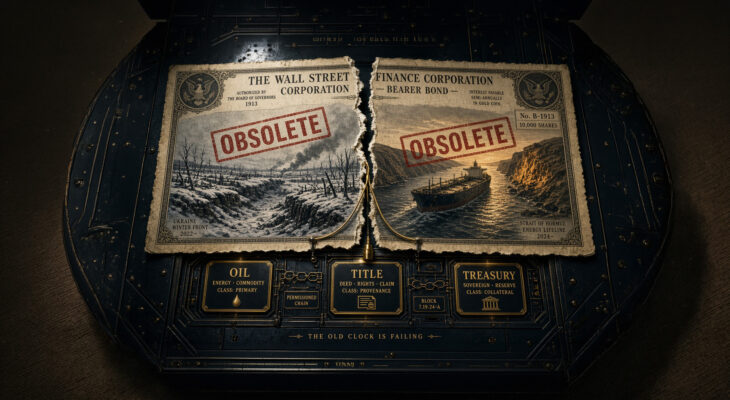
Ukraine and Iran are not two wars. They are one crisis with two fronts, and the banking giants/elites are using both to force you into a tokenized economic replacement.
Make no mistake, while governments talk pause and peace, the institutions that clear oil, debt, and reconstruction, who control currencies and the global flow of assets are already building the new digital rails for the coming change.
If you don’t bother to “look under the geopolitical hood” and continue to treat treat these conflicts as separate regional wars, you will fundamentally misread the next three years of prices, payments, and property.
I have been studying this strategic map from high altitude for years now: military briefers, former intelligence officers, European security scholars, and energy specialists all describe the same mechanisms even when they oppose each other’s politics.
The Donbas and the Gulf will not stay in their separate corners: “Because the machine that prices a barrel of oil, insures a tanker, rolls a Treasury, and finances a rebuild is one single global system, not a set of regional ones.”
And that machine is seizing up right now, so every part of it gets hotter.
Peace-talks no longer hold. Pressure (political and economic) has to move from one war to the other, and that has become the normal state of affairs.
Jump to Section:
- Who’s Behind This?
- Watch The Plumbing, Not The Podium
- The Nuts and Bolts
- Prediction For The Next 3 Months
- What You Can Do Now
- There’s Much More To It…
IMPORTANT: While this article goes into great detail, the full analysis, more predictions in greater depth, and an expanded list of recommended actions you can take to protect yourself right now, are available for our members. Find out more…
So Who’s Behind The Machine, The System, The Shared Interest?
Contrary to standard conspiracy theorist claims, what’s driving tokenization and the rollout of a new global economy forward is not some shady “Cartoon NWO Committee.”
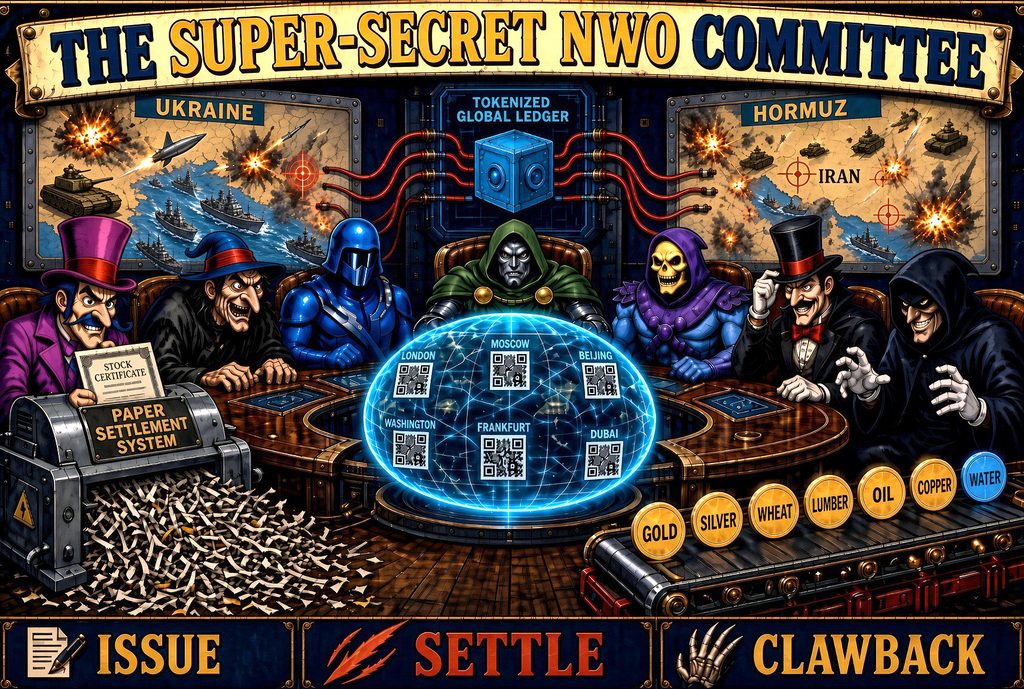
With that said… A lot of the real-world players pulling the strings do belong on one of those.
Behind what’s happening are the shared ledgers of the institutions that make their money from volume: banks, clearinghouses, prime brokers, commodity desks, reconstruction lenders, and the large custodians sitting on more than a hundred trillion dollars of securities. BlackRock. J.P Morgan. Goldman Sachs. Euroclear. State Street. You get the idea…
The problem they face is mechanical.
The postwar settlement stack (correspondent banking, multi-day clearance mechanisms, dollar wires, paper title, phone-and-telex energy trades) has reached end of life. It is slow, simple for a government to block, and too easy for a chokepoint (Hormuz, etc.) or a missile-hit on existing energy infrastructure to interrupt it.
By contrast Tokenization is “an entirely new settlement system,” not just “the new app” most people see it as.
It is replacement plumbing: assets become programmable claims; settlement collapses from days toward seconds or minutes; sanctions, compliance, and clawback become baked-in “features of the instrument” rather than a letter from a ministry.
FunFact: I laid the Hormuz-to-tokenization mechanism out in The Iran Oil Crisis. The institutional and quantum layer is in The Institutional Rebuild. The ownership shift (from a clear title you hold to a claim that can be instantly revoked or amended digitally) is in Tokenization and AI.

Crisis is how you retire the old reserve architecture without announcing the funeral.
The Strait of Hormuz is not a metaphor. It is VERY real. In a normal year it moves on the order of 20 million barrels a day of oil and products (about a fifth of global petroleum liquids consumption and a large share of seaborne crude) according to the U.S. Energy Information Administration. The International Energy Agency has put 2025 Hormuz crude alone near a third of total globally traded crude.
With those figures in mind, realize that the fighting “does not need to be about tokenization” for tokenization to collect the actual prize.
Break confidence in the old oil trade and every treasury, insurer, and sovereign fund asks the same question: “Which settlement rail still works when the payment network is a weapon and every tanker is a target?”
The answer is already conveniently on the table: digital title on permissioned and semi-public chains, dollar stablecoins as a bridge, tokenized claims on barrels, bills, and rebuild contracts.
Classic Hegelian Dialectic: Problem. Reaction. Solution.
The wars supply the first two. The banks supply the third.
Watch The Plumbing, Not The Podium
The Depository Trust & Clearing Corporation (DTCC) is the utility that finishes the digital trade after you click buy, the place Wall Street’s stocks and bonds are stored, matched, and handed from seller to buyer. It is the plumbing of the U.S. market, not just a trendy new company you’ve never heard of.
In December 2025 it partnered with Digital Asset to mint DTC-custodied tokenized U.S. Treasuries on the Canton Network, the recently purpose-built institutional ledger for issuance and private settlement. In May 2026 it declared that same tokenization service would connect to the Stellar public network, with DTC-custodied assets (major equities, index ETFs, Treasuries) targeted for the first half of 2027.
In market practice, Canton is the controlled issuance environment; XLM is the public-facing settlement instrument on the Stellar rail.
That is not a white paper.
That is the old bank cutting a new vault door while two “separate” high-profile wars keep the old door increasingly expensive.
Let’s look at Ukraine for a sec: A European land war that will not end cleanly is a manpower and human tragedy story at the front, and a purely material collateral story in Frankfurt, London, and New York. And when the guns pause, the financial controllers will offer tokenized farmland, municipal claims, rebuild bonds, trust-scored allocation of reconstruction capital, along with other “Hegelian solutions” to the damaged continent.
It’s not hypothesis… The same vocabulary is already being used for shattered districts in the wider Middle East: Proof-of-concept zones where aid, energy, and title can be issued (and revoked) as code.
When ownership becomes an arbitrarily revocable digital claim, “Digital Feudalism” stops being a vague metaphor.
You do not have to like that sentence.
You do have to notice the architecture going live right now, while Washington and Brussels officials and the mass media still file Ukraine and Iran in separate drawers.
The Nuts And Bolts
Quiet water in Hormuz and a settled eastern front would let the paper system limp on.
Escalation, spoiler risk around any Memorandum of Understanding with Iran, and a European war that grinds on endlessly keep insurance elevated, force non-dollar and token workarounds, and make “modernized settlement” look like safety rather than a complete global reset by the controllers.
“Same rulers… different rules.”
The houses that clear, custody, and refinance the world do not need to fire a single missile. They just need the old economic system to fail in public.
Countless military and political sources have been describing the linked conflict theaters for months.
The digital rails I’m focusing on are the missing paragraph from all those analyses.
What’s more, the switchover will not be clean.
Expect years of dual running: dollars and tokens, paper title and “digital twins,” physical sanctions lists written into tokenized wallets.
Meanwhile, households will encounter the switchover as fuel and food price spikes, as bank “upgrades,” as new identity checks on a payment, as the slow discovery that the asset they thought they owned is now “a permissioned instrument” whose “ownership” is instantly revocable if the system sees fit.
It’s not the end of commerce. It’s simply the end of the commerce we were trained to treat as natural.
Four Predictions For The Next Three Months
The Hormuz file stays “On-Pause” with a lit fuse.
There will be more political grandstanding and public “roadmap” and/or “victory” language, corresponding sanctions rhetoric, and sudden tanker-flow headlines… and at least one spoiler attempt, drone/missile strike, or leak aimed to sabotage any treaty or understanding in the region. The threat Is rael…
Do not look at ceremonies or headlines. Look at insurance premiums and chokepoint cargo volumes. If those do not stabilize and return to some kind of normality, the tokenization case writes itself into existence in “the pit of global energy shortages.”
The WTO’s own Hormuz tracker has already shown just how uneven a “reopening” of the Strait can be after a Memorandum of Understanding. Traffic volumes, tolls, and selective exclusion speak for themselves.
The midterm calendar, not a peace plan, will set the price of oil and the speed of the tokenization rails.
From now through November, Washington will treat a “quiet-enough” Gulf and a “sort of functioning” tanker market as a political necessity.
That produces the same split agenda I’m talking about: public talk of deals and reopenings, private urgency to get tokenized Treasuries, collateral, and dollar-stable settlement live in case the pause breaks.
Watch for the following “three tells” together: Higher U.S. gasoline and tanker-insurance prints, any escalated DTCC/Canton tokenization of existing treasuries, stocks, etc. and more frequent “campaign language” about “stability.”
If those diverge (cheap talk, expensive gas/insurance, accelerating digital rails) what happens in the next quarter is not de-escalation.
“It is a managed deployment window.”
Europe treats winter as a force-generation problem, not a peace problem.
Europe will spend the next few months arguing about the draft, about buying more shells and missiles, and about borrowing to pay for a bigger army. Those arguments will move faster than any speech about how the Ukraine war ends.
If the shooting does slow or pause, governments will call it “stability.” Meanwhile banks and reconstruction funds will treat it as a chance to sell rebuild plans and new debt.
Do not take any peace conference as a positive signal. Instead, read who is issuing the bonds, and for what.
“That is the real agenda.”
The rails go live in public while the wars stay “officially separate.”
Canton tokenization windows and the autumn institutional tokenization progression will be covered as mere market-structure news by most high-profile analysts.
In reality they are the successor system being pressure-tested while oil, Treasuries, and collateral are running politically hot. Sharp moves in gold, tanker rates, or short-end dollar funding (borrowing dollars for a few days or weeks) will be used to justify faster on-chain settlement “for safety.”
What ordinary people can do now
- Build a real buffer. Ninety days of household basics and cash outside the daily-spend budget. Payment glitches and supply interruptions will punish any household running “one delivery from empty.”
- Kill high-interest consumer debt. In a dual-rail transition, rollover credit is the first thing that gets insupportably expensive.
- Hold some value that is not someone else’s liability. Physical gold and silver, or allocated metal you have actually vetted and vaulted securely, sit outside the system’s mint-and-clawback1 design. It’s a Ballast, not a lottery ticket2.
- Treat tokenization as investment infrastructure, not a meme. Choose modest investment exposure only, prefer settlement rails with institutional counterparties, learn about self-custody before you need it.
- Cut single-point failure. A second skill, a second account relationship, paper copies of the documents your life depends on. Programmable systems fail when closed, which is to say they lock you out. Access stops. The payment does not go through. The token does not move.
A paper note in your drawer still spends even if the network is down.
- Read the room, not the jerseys. The operating question is: “Who writes the rule that freezes or permits your claim?” Keep track and keep your own records.
There’s Much More To It…
The old system will not announce its own funeral, and the new one will not ask permission before it settles your bill, your title, or your Treasury in code.
If you’re looking for actionable intelligence, more detailed predictions, and greatly improved recommendations on how to safeguard yourself and your family, BackToFreedom has the answer for you.
Joining “The Rekindled” is the next layer: deeper analysis, more and tighter predictions, and more detailed separate, practical instructions for households in North America and in Europe.
Join today. The window to reposition yourself is still open, but it will not stay open “on your schedule.”
1 Mint-and-clawback means a digital token can be created on a ledger and later frozen, seized, or reversed by the issuer. Coins in a registered wallet can be switched off. A bar in a vault you verified cannot.
2 Ballast, not a lottery ticket means this is weight to keep the boat upright, not a bet you hope goes to the moon. You hold metal so part of your savings is not someone else’s IOU. You hold it for insurance, not to get rich this week.


Wow. Deep intel