
The world is watching the Middle East news with a familiar mix of shock and resignation. Unprovoked American and Israeli strikes against Iran, missiles hitting Gulf oil facilities, oil prices spiking above $100 a barrel, and so on. It’s yet another chapter in the endless Middle East conflict, nuclear brinkmanship boiling over.
Or is it…?
Beneath the overt conflict lies a far deeper agenda: the rapid assembly of a new global economic system that has been under construction for years. This system is not primarily about war or ideology. It is about control through technology; it is a quiet shift from democratic nation-states and outright ownership to something best described as digital feudalism.
The blueprint for this shift is simple: Global technocracy (unelected experts in finance and technology) has captured the very populist movement that promised to fight it.
Instead of draining the swamp, the swamp has created a more sophisticated quagmire.
The ideology driving this movement comes from the so-called Dark Enlightenment, a Silicon Valley school of thought championed by figures such as Peter Thiel and Curtis Yarvin. It envisions replacing messy democracies with efficient “city-states” run like corporations by CEO-like rulers.
There are three practical tools for implementing the Dark Enlightenment vision:
- Tokenization of assets
- Artificial Intelligence for oversight
- A new governance structure that bypasses traditional checks and balances.
Tokenization is at the economic heart of the plan. Imagine turning every major asset, a house, a plot of farmland, a company share, or even future income streams, into a digital token recorded on a blockchain. You no longer own the thing outright in the old-fashioned sense. Instead, you hold a programmable digital claim that can be divided into tiny fractions, traded instantly across borders, and made subject to automatic rules.
The World Economic Forum has championed this vision for a decade. In 2016, Danish politician Ida Auken wrote a widely discussed piece titled “Welcome to 2030: I Own Nothing and Life Is Great.” In it, she described a future of subscription-style access rather than ownership: cars, homes, and appliances available on demand, managed by algorithms. The WEF later removed the essay after it sparked controversy, but the underlying idea never went away.
Their 2025 report, Asset Tokenization in Financial Markets, presents it as the next stage of finance, more efficient, inclusive, and liquid. Real estate, bonds, carbon credits, and commodities can all be “tokenized,” lowering barriers for small investors and speeding up transactions. Proponents promise democratized wealth. Critics see something else: ownership that is conditional, revocable, and ultimately controlled by whoever writes the underlying code.
That code lives in smart contracts, self-executing programs that run automatically when conditions are met. Think of them as unbreakable vending machines. Insert the right digital key, and the machine dispenses your asset or payment with no middleman. In a tokenized world, smart contracts can automatically collect rent, enforce usage limits, or even revoke access if your “social credit” score drops.
They power the WEF’s vision of programmable money and assets. Yet they are also dangerously fragile.
Security researchers track these weaknesses through the OWASP Smart Contract Top 10, an annual vulnerability list updated for 2026.
Top risks include faulty access controls (someone steals the administrator password and drains the entire fund), business-logic errors (a tiny math mistake in pricing allows attackers to borrow against nothing), and oracle manipulation (feeding false price data to trigger unfair liquidations). Flash-loan attacks amplify tiny flaws into multimillion-dollar heists in seconds.
In 2025 alone, smart-contract-related losses exceeded several billion dollars globally, with real-world asset (RWA) protocols alone losing more than $14 million in the first half of the year.
Even well-audited systems fail when code interacts with the messy real world. A single pricing glitch in a tokenized Treasury Bond could cascade through interconnected markets faster than regulators can react. The “code is law” promise of smart contracts becomes “code is fate” when the law cannot be changed after deployment.
These technological tools are already being tested in the Middle East.
Ten days before the Iran strikes, a new body called the Board of Peace held its first meeting in Washington.
Created by executive order rather than Congress, and chartered at Davos, it operates outside the United Nations mandate. Permanent seats on the Board reportedly cost $1 billion. President Trump chairs it. His son-in-law Jared Kushner and envoy Steve Witkoff sit on the executive board alongside Gulf partners. Just before Trump’s second inauguration in January 2025, an investment vehicle linked to UAE national security adviser Sheikh Tahnoun bin Zayed acquired a 49 percent stake in World Liberty Financial, the Trump family’s cryptocurrency venture, for $500 million. Shortly afterward, the United States approved large annual shipments of advanced AI chips to the UAE.
The Board of Peace’s designated payment system is World Liberty Financial’s USD1 stablecoin. At the inaugural meeting, officials already discussed replacing Gaza’s currency with this stablecoin and building a “secure digital backbone” for high-speed internet by July 2026. The plan is not charity. It is the installation of a total financial operating system on a captive population: every transaction visible, every account potentially revocable, every asset tokenized under Board oversight.
Gaza is the ‘proof of concept’ for things to come.
What is more, the current developments in the Middle East also coincide with the Israeli regime’s stated ambitons for a “Greater Israel,” which would encompass much of the local region.
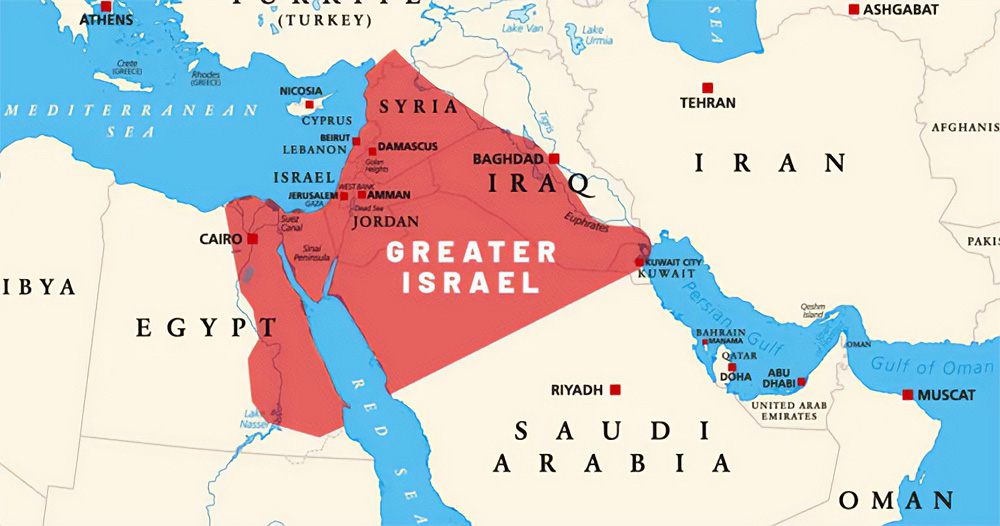
Benjamin Netanyahu publicly admitted to this.
In an interview on August 12, 2025 on i24NEWS the interviewer Sharon Gal showed Netanyahu an amulet/map depicting the “Promised Land”/Greater Israel” and asked if he felt connected to that vision. Netanyahu replied “Very much.” When Gal stressed “It is Greater Israel,” Netanyahu affirmed it and described his role as a “historic and spiritual mission” of generations: “There are generations of Jews that dreamed of coming here and generations of Jews who will come after us.“
Needless to say, this exchange triggered strong condemnation from Arab and Islamic countries, who called it a threat to regional sovereignty.
Now, just a few months later, Netanyahu’s assertions have suddenly become far more relevant, in view of regional developments and the ongoing “Operation Epstein Fury” against Iran, and not least because the coming tokenized economy would give Israel far tighter control over its “dominion.”
So What’s Next?
Here’s a potential forecast of what the next four to five years will look like if this architecture rolls out as planned:
(Bear in mind that the timeline is accelerating because technology moves faster than governments can regulate it.)
2026: Pilot and Stabilization. The immediate focus remains Gaza and post-strike Iran. USD1 stablecoin becomes the everyday currency for reconstruction contracts. Tokenized real estate and infrastructure projects launch, allowing Gulf sovereign wealth funds to buy fractional ownership. AI systems begin scoring populations for access to services. Oil markets stabilize above $90 per barrel as new pipelines and compute corridors link American tech exports to Gulf capital. Everyday citizens notice higher prices for imported goods and the first wave of “digital identity” requirements for cross-border payments.
2027: Scaling and Integration. The Board of Peace expands its mandate. Tokenization spreads to banking and insurance. Smart contracts handle automatic tax collection, loan enforcement, and carbon-credit trading. AI control layers sort citizens by risk and productivity scores. This is where early glitches appear, like a major oracle hack wiping out tokenized savings for thousands of small investors.
But the system is already declared “too big to fail.”
Middle-class families in developed nations start receiving offers to “tokenize” their homes in exchange for liquidity, often without fully understanding that ownership has become conditional.
2028–2029: Regional Rollout. The template exports to five likely next theaters, chosen for resource wealth, post-conflict vacuums, or strategic position:
- Syria: Post-Assad reconstruction mirrors Gaza, with oil fields and ports quickly tokenized.
- Lebanon: Chronic financial collapse leads to full currency replacement by stablecoins and tokenized debt.
- Yemen: Red Sea infrastructure comes under Board oversight, securing shipping lanes and resource flows.
- Ukraine: European testbed for AI-managed reconstruction and tokenized farmland.
- Venezuela: BRICS-aligned oil giant brought into the fold through resource tokenization, neutralizing a major rival financial bloc.
By 2030, the Board’s global charter activates in earnest. City-scale “special economic zones” emerge, governed more like corporate charters than democratic territories. AI surveillance and programmable money enforce compliance. Traditional nation-state welfare systems erode as access to services becomes score-based.
2030–2031: Consolidation. The architecture solidifies. Most major assets worldwide exist as tokens. Ownership feels like renting from an algorithm. Privacy fades; every transaction feeds the control layer. Economic inequality widens between those who code the rules and those who live under them. Occasional smart-contract disasters (perhaps a cascading failure in tokenized government bonds) trigger brief panics, but the system recovers by further centralizing oversight.
For ordinary middle-class families, the changes will feel gradual at first. Your mortgage might be replaced by a tokenized loan that adjusts payments automatically. Your retirement savings could be invested in fractional real-estate tokens whose value fluctuates with global events you cannot influence. Health insurance or travel privileges might depend on an AI-generated social score.
Convenience will be real, with instant cross-border payments, fractional ownership of luxury assets and such, but freedom will feel narrower. What you “own” can be frozen or devalued by code changes decided far away by an AI you had no hand in creating.
But none of this is Inevitable…
The simple fact is that “Understanding the system is the first step toward resistance.”
Democracies still have viable tools to influence and mitigate the developing technological control system: stronger regulation of smart contracts, insistence on legal overrides for code, and public scrutiny of bodies like the Board of Peace.
The coming years will test whether technology serves human liberty or replaces it. The bombs have fallen. Now a technological specter rises in their shadow.
The choice, for now, remains ours… if we choose to acknowledge the risks and act against them.
Critical Takeaways
- Understanding Precedes Resistance: The first and most important act is to recognize the architecture. Events that appear chaotic or personality-driven (wars, diplomatic deals, crypto ventures) actually serve a coherent engineering specification.
- Democracy vs. Technocracy: The system substitutes “What does the system require?” for “What do the people want?” Traditional democratic consent is being replaced by technical administration.
- Risk Concentration: While tokenization and smart contracts promise efficiency, their fragility (demonstrated by repeated multi-million-dollar exploits) creates systemic vulnerabilities that could cascade rapidly in an interconnected tokenized economy.
- Power Concentration: American diplomatic authority, Gulf capital, Trump-family crypto ventures, and Silicon Valley ideology are fusing into a hybrid public-private governance model with limited or no accountability.
- Window of Opportunity: The years 2026–2028 represent the critical rollout phase. Public awareness, stronger regulation of smart contracts, insistence on legal overrides for code, and scrutiny of bodies like the Board of Peace can still shape (or limit) the worst outcomes.
- Middle-Class Reality Check: The changes will arrive gradually through seemingly beneficial offers (“tokenize your home for liquidity,” digital IDs for faster payments.) By the time the conditional nature of ownership becomes obvious, the infrastructure may already be too entrenched to reverse easily.
The time to push back is NOW, not when it’s too late.