
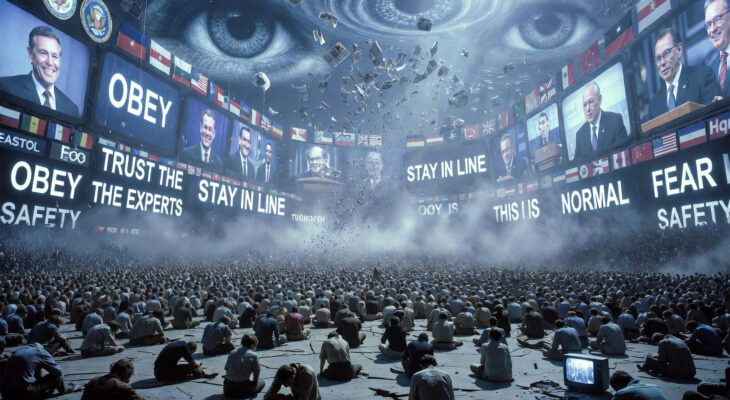
It is a fact well known to those who know me that I’ve been operating in the computer and Internet sector for well over three and a half decades, including fifteen years as a troubleshooter for Google, solving problems for companies around the globe, including some of the world’s largest corporations. My professional time has also included training in deception detection and information operations, because you don’t spend any prolonged time working around corporate middle-management without figuring out that those guys LIE A LOT.
In short, I’ve spent a significant amount of my career troubleshooting, dissecting, and eventually defending against systems designed to shape human behavior at scale.
What started as essential professional knowledge of user interfaces and recommendation algorithms evolved into a far deeper study of how those same tools can be (and have been) weaponized to erode agency.
Wait! What? Erosion of Agency?
Yup, that… A systematic undermining of an individual’s or group’s perceived and actual capacity to influence outcomes through their own actions, the slow erosion of the belief (eventually leading to the actual reality) that collective effort can meaningfully shape personal or societal results, engineered at scale, Through daily exposure to online information systems, media narratives, and social incentives, active citizens are transformed into passive spectators who have internalized the conviction that “nothing I do matters.”
Glad we cleared that up…
Anyhow, one psychological concept I have returned to repeatedly is Learned Helplessness, a phenomenon first rigorously documented by psychologists Martin E. P. Seligman and Steven F. Maier way back in 1967. The concept was developed during a series of experiments involving a fair amount of animal cruelty. Here, dogs were subjected to repeated inescapable electric shocks. Later, those same animals failed to escape even when an obvious escape route became available… because they had permanently been conditioned to accept the futility of their escape efforts.
Seligman extended this insight to humans, linking it to depression, passivity, and diminished motivation.
The core mechanism affects cognition: repeated exposure to uncontrollable aversive1 events teaches the subject that outcomes are independent of their own actions. Once that expectation sets in, initiative collapses, even when real leverage for positive change exists.
From the information-saturated/overloaded professional environment I have experienced within Big Tech, I can safely say that “Learned Helplessness” is no longer merely an individual pathology. It has become a scalable social technology used to exploit our collective consciousness.
Propaganda and digital platforms now DELIBERATELY INDUCE LEARNED HELPLESSNESS in populations to discourage organized resistance and preserve existing power structures.
“Where there is no hope, there is no resistance.“
And with all that said…
I’m going to break down how you can spot the techniques being used on you in your daily life, and what you can do to fight against the disastrous effects of this heinous mind-control campaign being perpetrated against humanity.
A. Spotting the Techniques: How Learned Helplessness Is Engineered at Scale
Realize this first: Propagandists and platform designers do not need to employ overt coercion to force your acceptance/compliance TO ANYTHING, nowadays.
They exploit the same pattern-learning circuitry Seligman identified decades ago: Flood the system with uncontrollability until all resistance effort feels pointless.
Four primary tactics (drawn from documented propaganda models and amplified by digital architecture) are most commonly used against you:
1. The Firehose of Falsehood
Coined by the RAND Corporation in its 2016 analysis of Russian information operations, this tactic floods audiences with high-volume, multichannel messaging that is rapid, repetitive, and indifferent to truth or consistency.
Social media timelines, 24/7 cable news, and coordinated bot networks now deliver contradictory claims faster than any individual can verify them, unless they have the will, ability, and time to do so.
The cognitive overload produces exhaustion rather than enlightenment.
Consequently you abandon the pursuit of truth altogether, defaulting to apathy or “culty” tribal groupthink instead.
In my time at Google, I watched engagement metrics on Youtube and Google+ reward precisely this pattern: outrage and novelty drive dwell time, while coherence is penalized. The result is not belief in any particular lie, but the learned conviction that no reliable signal exists.
The result? Apathy and Passivity in the VAST majority of the audience…
2. Institutional Inevitability
There’s nothing the machine loves more than to insist that the system (whether the administrative state, global finance, or technological infrastructure) is too vast, too rigged, or too inertial to be altered.
Slogans such as “both sides are the same,” “the deep state always wins,” or “you can’t fight government in the algorithm age” constantly reinforce the public perception that there’s ZERO relationship between citizen action and societal outcome.
This mirrors the shuttle-box phase of Seligman’s experiments: even when escape is possible, the subject’s prior conditioning blocks the attempt to flee.
The technique is especially potent when paired with selective reporting that highlights elite impunity while ignoring existing incremental victories by organized citizens.
3. Crisis Normalization and Doom-Scrolling
Continuous, relentless coverage of existential threats, economic precariousness, climate collapse, perpetual conflict, without the necessary/relevant emphasis or focus on solutions or positive historical precedents of collective action, creates a background hum of uncontrollability to your everyday life.
Media ecosystems profit from this “manufactured despair.”
And not just where advertising revenue is concerned… Crisis Normalization is one of the most potent social control mechanisms of them all. Not only does it instill a sense of helplessness, but it quietly foster-hopelessness and the cancerous attitude that without the-powers-that-be standing in between you and [insert current threat,] your head will be on the chopping block next.
What’ll it be? Islamists with nukes? Republican/Democrat destruction of the nation? Russia! Russia Russia!? The Robocalypse? Something else?
Anything but israel’s genocidal wrongdoings or its toxic influence on sovereign nations, right?
The psychological effect is parallel to inescapable-shock pre-conditioning: the brain learns to conserve energy by ceasing to search for escape routes.
Algorithmic curation exacerbates it further; my engineering colleagues and I saw firsthand how negative-emotion-weighted recommendations kept users in doom loops because despair correlates with higher session length… and greater advertising revenue.
4. Performative Repression
High-visibility punishment of low-impact dissent (arrests for minor protests, de-platforming, or selective prosecutions) signals that resistance carries asymmetric penalties while systemic change remains impossible.
The overall effect is chilling and deliberate: Most citizens will never actually test the activism-barrier because the mass-publicized failures have already taught them that “resistance is futile.”
Combined with selective amplification of failed movements, this creates a feedback loop of observed, documented helplessness.
Additional vectors I’ve seen frequently used include algorithmic echo-chamber reinforcement (which narrows your perceived range of actions/options) and the deliberate conflation of correlation with causation in crisis narratives… “Recession is caused by tariffs” is one such false ‘correlation equals causation‘ fiction.
Both of these vectors further deepen the “nothing I do matters” mental attitude.
B. Fighting Learned Helplessness: Personal Agency and Societal Countermeasures
The encouraging results from fifty years of follow-on research is that learned helplessness is reversible.
Seligman himself shifted from studying helplessness to developing Learned Optimism,a trainable cognitive skill set. Both individual resilience and collective renewal are possible.
Here’s What To Do On the Personal Level:
- Scutinize and Reclaim Your Information Intake: Your attention is a scarce, finite resource. Treat is as such.
Segment and curate your information-feeds deliberately; mute outrage channels, impose topic-delineated consumption limits, and seek primary sources wherever you can.
As an Techie/Troubleshooter, I apply the same discipline to my own media diet that I apply to corporate disaster recovery: Work with facts and data, not agenda-driven middle-management narratives. Follow where the logic leads and always keep an eye on who objectively has the most to gain or lose from any given situation.
“Following the Money/Benefit” will almost invariably lead you in the right direction.
- Practice Micro-Experiments in Taking Action: Seligman’s later work showed that even small, controllable successes rebuild expectancy of control. Start with low-stakes actions whose results you can directly observe and measure: local community projects, skill acquisition, or targeted advocacy. Track their cause and effect diligently.
- Reframe Attributions: Challenge the Three Pees of pessimistic explanatory style (Personal, Pervasive, Permanent.)
When a setback/situation is thrust in your face, ask:
- Is this my fault alone?
- Does it ruin every domain of life?
- Will it last forever?
Cognitive-behavioral techniques, mindfulness, and deliberate journaling will accelerate positive rewiring.
- Build Physical and Social Buffers: Exercise, sleep, and real-world relationships are non-negotiable to your mental health.
Isolation amplifies helplessness; community restores it.
And On the Societal Level:
Individual resilience scales poorly without structural/community support. Societal Learned Helplessness Countermeasures must operate at the level of information architecture, organizational hierachies, and civic norms:
- Media and Digital Literacy is Crucial: Educate yourself first, and then openly publicize and campaign for education in source evaluation, statistical literacy, and algorithmic manipulation2.
Platforms like X, Youtube, and Facebook, who are the most pervasive propaganda agencies spreading learned helplessness, should face transparency requirements for algorithmic weighting of evidence versus emotive content. That’s only going to happen through public pressure.
Don’t let anyone tell you otherwise. - Restore Positive Visibility: Journalism and civic education must highlight solvable problems and success stories of citizen action, not merely act as a “catalog of crises.”
Focus on positive outcomes. “Solutions journalism” and rigorous after-action reporting on public pressure and policy experiments counteract Learned Hopelessness Normalization. - Decentralize and Diversify Information Flows: Support independent, verifiable institutions, libraries, open-source tools, local groups and assemblies, that operate outside centralized, “approved” recommendation systems.
- Organize at Human Scale: Mass movements fail when atomized; organized, federated, face-to-face networks succeed because they restore observable connection between effort and outcome.
Fun Fact: Literally 95% of the online ecosystem is 100% geared to keep any kind of resistance against it atomized. You can see this for yourself, if you’re paying attention.
The next time you see someone online suggest taking action or forming an organization, notice how quickly the influencers around you accuse them of being a “Fed” or being a “Shill” for some institution or another.
That’s not an accident; it’s the result of of concerted social programming to keep us all distrusting each other to prevent effective resistance.
But in any case, historical examples of successful community and citizen action abound, from labor rights to environmental victories, if only you bother to research for a moment… But it takes organization and effort to make them successful.
Having helped to troubleshoot the systems I’m talking about, I can say without a shadow of a doubt that engagement-maximizing algorithms are not neutral.
It is up to each of us to study the techniques used to persuade us that our fate is inescapable. And Once we have a grasp on how we’re being influenced it’s our responsibility to educate others so they too have the tools necessary to escape their propagandization.
Always remember that learned helplessness is not an inevitable feature of complex societies; it is an engineered outcome of specific design choices in media, technology, and politics.
Those choices were made by humans… and they can be unmade by other humans exercising the very agency/activism which media and government seeks to suppress.
If my professional experience has taught me anything, it’s that every system has leverage points for change, and that YOU need to realize those points exist… no matter who’s trying to convince you otherwise.
The first act of resistance is to reject the learned conviction of futility. The second is to act, however modestly, and document the positive results.
Truth and Action are contagious.
So are passivity and apathy.
Choose wisely…
1 Aversive (in the context of Learned Helplessness and this article) refers to any unpleasant, painful, stressful, or threatening stimulus or event that any sane being would naturally seek to escape or avoid.
2 Here are some resources to get you started: The CRAAP Test, Statistical Literacy, Algorithmic Manipulation