As a German who’s old enough to remember the fall of East Germany and the Berlin Wall in 1989, shortly followed by the collapse of the Soviet Union in 1991, I observed that the most consequential shifts often begin not with dramatic battlefield victories but with quieter erosions of internal national cohesion and subtle realignments among key actors.
The April 29, 2026, edition of Judging Freedom hosted by Judge Andrew Napolitano provided a lucid snapshot of precisely such dynamics. Analyst Gilbert Doctorow, drawing on Russian polling data and domestic media discussions rarely highlighted by Western media coverage, described measurable frustration inside Russia over President Vladimir Putin’s handling of the Ukraine conflict and the economy. Complementary segments with Pepe Escobar, Phil Giraldi, and Mohammad Marandi illuminated the deepening Russia-Iran partnership and its implications for regional stability.
Together, these developments signal a period of internal recalibration in Moscow that is simultaneously reinforcing a broader multipolar global reordering with significant sociopolitical consequences across Eurasia and beyond.
Doctorow’s assessment, grounded in recent independent polls and open commentary on Russian state television, is instructive. Putin’s approval rating, long sustained above 80 percent, has declined to approximately 70 percent. More revealing is the ruling United Russia party’s slide to roughly 20 percent in voter intent, down from a historical baseline near 30 percent.
Although the party retains its legislative supermajority through long-standing electoral mechanisms, like adjustments to party lists versus single-mandate districts, these arrangements have themselves been the subject of candid discussion by senior Russian political figures, including the late Vladimir Zhirinovsky. The upcoming State Duma elections, statutorily required by late September 2026, could mark the most politically significant vote in Russia since 1996.
And while no collapse is imminent, the data points to accumulating war fatigue and economic dissatisfaction that constrain Putin’s freedom of action on the international stage. Frustration is not confined to ordinary citizens; it registers (albeit more privately) among Kremlin insiders and broader elites… oligarchs, academics, and media influencers, who have grown accustomed to a different calculus of risk and reward.
This domestic pressure in Russia does not occur in a vacuum.
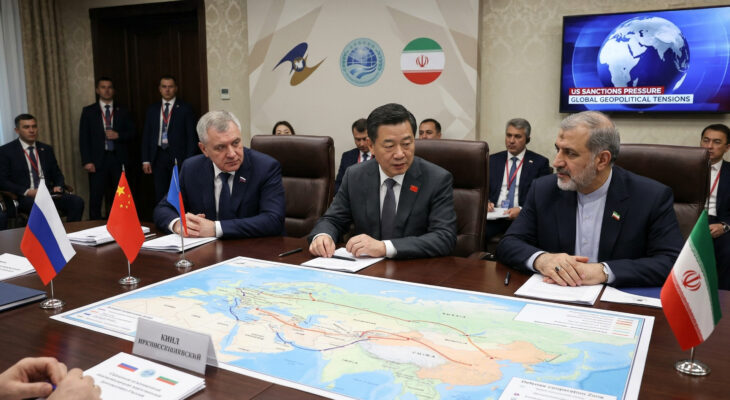
It coincides with a strategic deepening of ties with Iran. Escobar and Marandi highlighted the recent high-level meeting in St. Petersburg between Putin and Iranian Foreign Minister Araghchi, which underscored Moscow’s commitment to Iranian sovereignty and mutual support in the face of external pressures. For Russia, Tehran serves as a critical buffer for its southern flank and a reliable partner in challenging Western dominance. For Iran, the relationship provides diplomatic cover and material backing at a moment of heightened regional tension.
The alignment is pragmatic rather than ideological: both states see value in resisting what they perceive as unilateral attempts to dictate the terms of the global order.
The sociopolitical ramifications of these developments are already visible and will intensify in the short to medium term. In Russia, sustained war fatigue risks eroding the social contract that has underpinned stability for more than two decades. A younger generation less inclined to accept prolonged conflict, combined with elite unease over economic stewardship, could foster a more cautious foreign policy posture, even as official rhetoric remains firm.
Public discourse, though channeled through permitted forums and social networks, increasingly reflects a desire for recalibration rather than confrontation. This internal dynamic may limit Moscow’s appetite for escalation elsewhere, subtly shifting the balance of initiative toward diplomatic maneuvering.
In Iran, the partnership with Russia offers a measure of resilience against isolation, yet it also exposes Tehran to the domestic costs of prolonged external pressure. Public sentiment, as conveyed by Marandi, shows a society hardened by sanctions and conflict but increasingly attuned to the human and economic toll. Short-term effects may include greater consolidation around the clerical leadership as a rallying point against perceived external threats, while mid-term pressures could encourage pragmatic adjustments in economic and diplomatic strategy to maintain internal cohesion. The sociopolitical fabric of Iranian society, already shaped by decades of revolutionary ideology and external adversity, will be tested by the need to balance defiance with the practical demands of governance.
Broader regional and global ripples are equally consequential.
NATO’s cohesion has been showing visible strain for some time now. Turkey’s President Erdogan has issued sharp public criticisms of Israeli leadership and raised the prospect of direct military involvement, while traditional European allies have remained notably restrained amid reports of significant Israeli casualties. These fractures expose the limits of post-World War II alliance structures when core national interests diverge.
In Europe, the combination of energy uncertainty and war fatigue is fueling domestic political debates about strategic autonomy versus continued alignment with Washington. Public opinion in several member states is increasingly skeptical of open-ended commitments, potentially accelerating populist or realist currents in upcoming elections.
Three Forward-Looking Predictions:
- In Iran, the short-term effect of closer Russia ties will be a consolidation of domestic political support around the current leadership, framed as necessary resistance to external coercion.
By the mid-term (12–24 months), however, sustained economic strain may prompt a more pragmatic faction within the elite to push for selective diplomatic openings, even while maintaining the core strategic partnership with Moscow and Beijing.
This could manifest as a subtle evolution in public discourse—from outright defiance toward a narrative of “principled endurance” that preserves regime legitimacy without provoking wider confrontation.
- China will quietly capitalize on the Russia-Iran dynamic to deepen its influence across the Global South and Central Asia. In the short term, Beijing will position itself as a reliable diplomatic and economic partner, avoiding direct military entanglement while benefiting from the distraction of Western military resources.
Over the medium term, this will strengthen the multipolar narrative domestically, reinforcing Xi Jinping’s emphasis on national rejuvenation and providing sociopolitical ballast against internal economic challenges.
The Primakov Triangle (Russia-Iran-China) will evolve from tactical alignment into a more structured framework for coordinating positions on energy routes, technology standards, and international institutions.
- The combination of Russian domestic constraints and regional tensions will accelerate political recalibration in Israel and key European capitals.
Short-term, Israel may face heightened domestic pressure to manage escalation risks amid alliance uncertainties, potentially leading to more assertive diplomatic outreach.
In Europe, mid-term parliamentary cycles will likely see gains for parties advocating reduced foreign entanglements, contributing to a broader erosion of transatlantic consensus. Sociopolitically, this could foster a generation of European leaders more focused on continental self-reliance, reshaping public expectations about security guarantees, and prioritizing economic factors.
For those of us who have witnessed the end of the Cold War, the 2008 financial crisis, and the upheavals of the past decade, these developments underscore a central truth: Legitimacy (both domestic and international) remains the ultimate currency of power. The strains visible in Russia today are not isolated; they are symptomatic of a wider re-negotiation of how states derive authority from their populations and project influence abroad. The short to medium-term outlook points to a more fragmented but also more pragmatic international environment… one in which careful diplomacy, alliance management, and domestic consensus-building will matter as much as raw military or economic might.
Awareness is the first form of preparedness, as those of us who have built careers and families through periods of uncertainty fully understand.
Therefore, closely monitoring the September 2026 Duma elections, the evolution of Russia-Iran coordination, and the subtle shifts in European and Middle Eastern public sentiment will provide early signals of how this realignment will unfold.
In an era when great-power competition increasingly intersects with questions of internal resilience, the most effective strategy remains the same: stay informed, think in terms of decades rather than headlines, and recognize that the wider geopolitical theater ultimately shapes the stability and opportunities available to all of us.