
Those of you who know me personally, will know that I’ve spent decades watching and analyzing energy chokepoints, alliance fractures, and the slow-moving machinery that powers the global economy and the march towards the New World Order.
During this time I’ve seen enough flashpoints to recognize when surface headlines hide a deeper restructuring.
What unfolded today (April 17, 2026) fits that pattern exactly.
Iran’s foreign minister declared the Strait of Hormuz “completely open” to commercial vessels for the remainder of the Israel-Lebanon ceasefire. President Trump quickly posted that the waterway is “ready for business and full passage,” but he immediately added that the U.S. naval blockade on Iranian ports and shipping “will remain in full force” until a comprehensive deal (including nuclear issues) is 100 percent complete.
This is corroborated by shipping trackers, which show only a handful of vessels moving, with several turning back. Oil prices plunged on this news, yet uncertainty still lingers amid conflicting reports emerging in news outlets and online.
Let me lay out what actually happened, what it reveals, and what it likely means for the months ahead.
The Blockade, Iran’s Toll Strategy, and Today’s Announcement
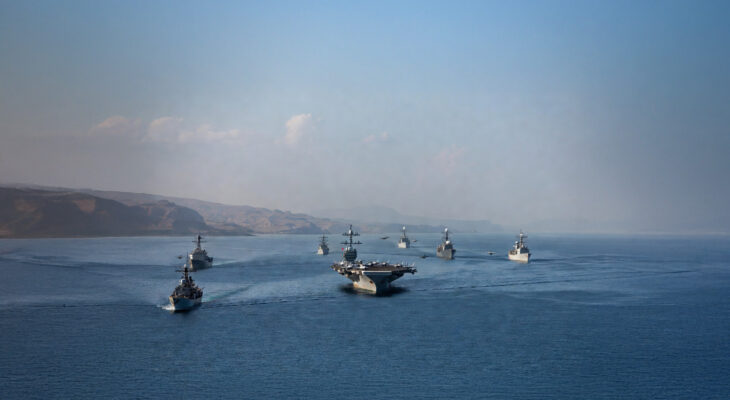
For the past several days the Trump administration enforced a targeted naval blockade on Iranian ports and Iranian-linked vessels in the Strait of Hormuz.
Meanwhile, Iran had been operating its own selective system: BRICS-country ships passed freely while Western tankers faced fees of roughly $2 million per transit, payable in yuan or crypto. At peak volume that policy could have delivered Iran more than $260 million a day.
Today’s announcement changes the optics but not the fundamentals. Iran says commercial traffic can now use “coordinated routes” it controls. Trump welcomed the opening yet kept the U.S. blockade firmly in place for anything Iranian. Real-world traffic remains minimal… far below pre-crisis levels, and shipping companies are still exercising extreme caution. Some Iranian hard-line voices have also warned that continued U.S. pressure could prompt new restrictions or “Iranian authorization” requirements.
In short, both sides are claiming victory while the waterway continues to be partially paralyzed. Saudi Arabia, meanwhile, is routing more oil through its East-West Pipeline to Red Sea terminals at Yanbu, bypassing the Gulf entirely and keeping its exports steady.
Europe Charts Its Own Course… and NATO Increasingly Shows the Strain
The second major development is Europe’s accelerating independence. France, the UK, and Germany are drafting plans for a post-ceasefire naval coalition that deliberately excludes the United States, Israel, and Iran. President Macron has called it a mission for “non-belligerents.” The UK has pulled together a 41-nation group, inviting China and India, to discuss mine-clearing and secure shipping lanes.
This is Europe saying it will protect its own energy lifeline without waiting for Washington.
At the same time, Turkish President Erdogan has sharply escalated rhetoric, labeling Israeli Prime Minister Netanyahu “the Hitler of our time” and hinting at military options against Israel. Both Turkey and Israel are NATO members. And Turkey brings credible military capability to this table, like advanced drones, precision missiles, the West’s largest standing army, and a large contingent of upgraded Leopard 2 tanks… making its threats more than just bluster.
The NATO alliance is visibly stressed.
The Larger Reset: Disruption as Strategy
After reviewing the available data, diplomatic releases, and energy-market models, here’s my conclusion: this is not a short-term tactical win for any single player.
Instead, the disruption itself “IS” the point.
Iran loses revenue and infrastructure. Iraq, Qatar, Kuwait, and Iran face economic isolation. Europe and India absorb higher import costs. Even Saudi Arabia, despite its successful rerouting of oil exports, worries that Iran could strike the Bab al-Mandab Strait and choke its Red Sea alternative.
The net result is a forced reformat of global energy politics, where old proxy networks are being dismantled, new corridors and payment systems (notice the yuan and crypto already appearing in tolls) are emerging, and traditional power structures are losing their monopoly.
As a quick sidenote, financial markets are quietly accelerating the tokenization of real-world assets and debt to support this transition. Major banks are already briefing high-net-worth clients on real-time valuation of everything from federal lands to student-loan portfolios. It’s happening in the background, not as the headline.
I wrote about that earlier this week. Check it out…
Three Near-Term Predictions You Can Actually Use
- Oil-price volatility will stay high through the rest of 2026 and into early 2027. Banks have already revised forecasts upward, with Goldman Sachs now eyeing Brent averaging $85 with possible spikes to $110; ANZ sees sustained levels above $90; the EIA lifted its 2026 outlook to $79. Today’s announcement triggered an 11 percent drop in oil futures, but that relief could prove temporary. If Bab al-Mandab comes under pressure or negotiations stall, $100–$150 Brent remains on the table.
For ordinary households this means higher surcharges on deliveries, airfare, and manufactured goods. My practical advice: keep your gas tank topped off and consider modest pantry stocking while prices are still relatively calm. - NATO will face its most serious cohesion test in decades. Turkey’s threats, Europe’s independent Hormuz planning, and Germany’s silence on the Israel/Iran conflict point to a summer of difficult summitry. I expect Ankara to push for a “reset” at the upcoming NATO meeting and for bilateral deals to proliferate outside the alliance framework. The alliance will not formally break, but its operational unity will erode, forcing the United States to lean more heavily on selective partnerships.
- A more multipolar energy map will take visible shape by late 2026. Saudi and Emirati Red Sea capacity will expand. India and China will deepen yuan-based oil trades. European strategic reserves will shift toward faster Suez access. At the same time, we will see the first practical steps toward tokenized payment rails for energy contracts… not as grand theory but as a pragmatic response to dollar fatigue and the resultant chokepoint risk. For investors and business owners, this means keeping an eye on diversified commodity exposure and stablecoin or real-asset pilots from major banks.
What This Means for Everyday Families
I’ve watched enough cycles to know that most families don’t track tanker routes until the price at the pump jumps. up This time the connection is direct and the timeline is short. Today’s conflicting announcements (open in name, still restricted in practice) illustrate how quickly the Bretton Woods system is being stress-tested and partially replaced.
What Do I Mean By This?
The post-1945 energy order you and I grew up with… the one that made the U.S. dollar the undisputed king of global trade because oil was priced and settled in dollars, was built squarely on the foundations of the Bretton Woods framework. That system, originally designed in 1944 with fixed exchange rates and gold-backed dollars, evolved after 1971 into a dollar-centric arrangement held together by petrodollar recycling and American military guarantees over key energy chokepoints like the Strait of Hormuz.
Today that entire architecture is under deliberate stress and is being quietly replaced. The Hormuz blockade, Saudi rerouting, European go-it-alone naval planning, and the sudden appearance of yuan and crypto payments for tanker transits are not random events; they are actively dismantling the last pillars of Bretton Woods II by forcing real-time revaluation of energy assets, accelerating tokenized stablecoins backed by U.S. debt, and shifting the world toward a multipolar system where no single currency or military power enjoys the same automatic dominance. In plain terms, the old rulebook is being retired, and a new one, built on tokenized rails, diversified energy corridors, and real-time asset pricing, is taking its place.
The good news is that markets and governments are already adapting; Saudi rerouting proves resilience exists. The challenge is that adaptation brings volatility, and volatility hits household budgets first.
Stay informed, keep your finances balanced, and avoid knee-jerk reactions to headlines. Diversified assets, some cash liquidity, and a measured approach to commodity exposure will serve you better than panic buying or selling.
Diverified Assets? Cash Liqiudity? Measured Commodity Exposure? What the HELL?!
Yeah, OK… I know I’m throwing jargon around again, so let’s break that down for a moment before I wrap this up.
You know that old saying about ‘not putting all your eggs in one basket?’
That’s what I mean by Diversified Assets. We’re moving into a time of economic stress and likely hyperinflation, where your Dollar will lose purchasing power basically by the day. This likelihood necessitates an approach by ordinary folks like you and I, to “think off the beaten path.”
Let me give you a VERY CONCRETE historical example of what I’m talking about:
Those of us old enough to remember the collapse of the Soviet Union have seen EXACTLY what happens when hyperinflation strikes a nation.
Back then, Russia descended into hyperinflation and severe shortages that rendered the ruble nearly worthless, with inflation peaking at 2,500% in 1992. Consequently a massive barter economy emerged in which everyday goods with stable value became de facto currencies. Vodka and Marlboro cigarettes stood out as the premier “liquid money”: repairmen, taxi drivers, and even government officials routinely accepted bottles or packets instead of cash, factories bartered it for raw materials, and in 1998 authorities in Siberia’s Altai region even paid thousands of teachers their wages in vodka. Other items such as bricks, towels, shoes, and factory-produced goods also circulated as informal currency, allowing people to trade for food, services, and building supplies when cash failed.
This makeshift system was a pragmatic survival mechanism during the chaotic transition to a market economy.
Is this likely to happen in Western nations today?
Maybe not… But the simple fact is that commodities and hard assets skyrocket in value during hyperinflationary and economically stressed times, so look to more solid propositions like energy and mining stocks, copper, silver, gold, etc.
Cash Liquidity is also about more than keeping some Dollar bills under your mattress. In times of economic stress, precious metals are an excellent source of instant liquidity, as well as a great store of wealth in addition to cash reserves.
Measured Commodity Exposure simply means holding a modest, deliberate, and diversified slice of your overall portfolio in commodities… things like crude oil, gold, silver, copper, or even certain commodity-linked ETFs. In that way you can participate in the upside from the energy and resource volatility we’re seeing right now, without betting your shirt on any single outcome.
And always remember… What I’m laying out here is a long-term wealth preservation strategy to take you into the coming tokenized economic system, not a quickfire short-term solution.
I hope that clarifies things adequately… Let me know in the comments whether anything remains unclear.
In the meantime I’ll keep monitoring the shipping data, diplomatic cables, and oil curves, and I’ll share clear updates as the picture sharpens.
So breathe easy but stay alert. The world is rearranging its energy arteries in real time, and the next few quarters will test how well we’ve prepared.
The fundamentals haven’t changed: energy still powers everything we do, and whoever controls the flow writes the next chapter of the global economy.