
I’ve spent decades analyzing markets, technologies, and the gradual structural shifts that quietly separate winners from those left reacting after it’s already too late. From the internet boom, through market crashes, to the crypto maturation we’re living through now, one lesson stands out:
The largest wealth transfers don’t happen through dramatic crashes or windfalls, but through economic divergences that most people only notice once they’re already positioned on the wrong side of them.
Such a divergence is once again upon us, and it’s called the K-shaped Economy.
Imagine two lines starting from the same point sometime in mid 2025. One curves sharply upward, compounding asset values, influence, and positive choices. The other drifts gradually downward, slowly eroded by inflation, technological displacement, and an economic playbook written by others.
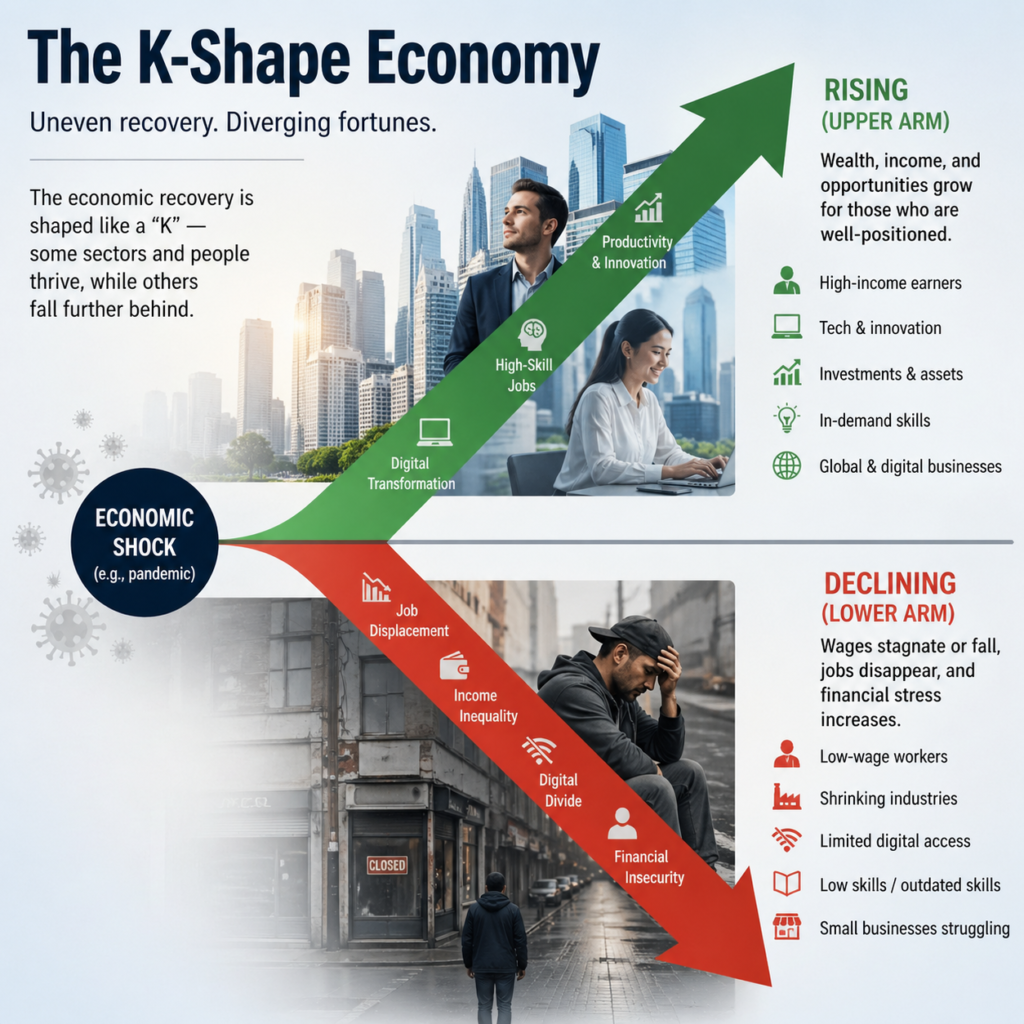
The deciding factor of which line you end up on isn’t your starting net worth, your education level, or even your age. It’s simply whether you learn to treat artificial intelligence as a genuine force multiplier for your time, capital, and output… or keep trying to compete against it with yesterday’s tactics.
I’ve been “The Disaster Recovery Guy” for longer than I’d care to remember, and I can confidently tell you the upper line is actually far more accessible to you than headlines might suggest.
You don’t need to be a billionaire or a Silicon Valley insider to play this game…
Educated professionals, successful small-business owners, and thoughtful savers with some accumulated assets are exactly the people I see successfully moving onto that upward trajectory.
The lower path of gradual but persistent erosion, is simply the default if you continue to do nothing to adapt, from here on in.
Let me share what I’m seeing in the data and conversations I follow daily, why it matters deeply for people like you, and five concrete, low-barrier actions I’m recommending right now to help secure your place on the K’s upper arm.
Understanding the K-Shape Economy in Everyday Terms
The upper arm belongs to those who treat AI as a system that multiplies their productivity rather than replaces it. They build or direct intelligent agents, eliminate bottlenecks in their operations, and capture far more value from the same hours and dollars they would normally expend day-to-day.
The lower arm is where people wait for defined clarity, continue operating legacy business models, or simply hope the old rules still continue to apply.
Here inflation quietly chips away at savings that aren’t growing faster than the new economy erodes them. Skills and enterprises that don’t incorporate AI become progressively less relevant, as their productivity is vastly outpaced by early adopters of the new systems. And as time passes, regulatory and market changes increasingly favor those already structured to adapt over those stuck in the old paradigm.
This isn’t just abstract theory.
Institutional reports and market data from the first four months of 2026 show the pattern accelerating. AI-driven capital spending is reshaping entire sectors, while tokenized real-world assets (everything from U.S. Treasuries to real estate deeds) are moving onto blockchains where they can be traded 24/7, borrowed against without selling, and used to generate yield.
Stablecoins have become the practical “digital dollar rail,” offering yields of 5% to 12% or even more on regulated platforms, while remaining easy to spend or transfer globally. The Lightning Network, Bitcoin’s layer-2 solution, is already handling billions in monthly volume and powering instant, near-zero-fee payments in apps like Cash App and merchant terminals.
At the foundation of all this is a simple physical reality: AI at scale requires enormous, reliable energy. That’s why major technology companies are investing heavily in advanced nuclear capacity and grid infrastructure, precisely because AI’s computational demands can’t be met by the fragile or intermittent power sources of today’s grid.
For individual investors, this creates a clear economic signal: Exposure to the data-energy nexus is becoming a core wealth-preservation and growth theme.
Tokenization is quietly unlocking trillions in previously illiquid value. Real estate deeds, company shares, bonds, and even future private equity can now be turned into programmable digital tokens. This lets owners trade fractions instantly, borrow against them via smart contracts, and avoid lengthy traditional processes.
BlackRock’s tokenized treasury products and Fannie Mae’s acceptance of crypto-collateral for mortgages are early proof points, the canary in the digital coal mine if you will. Additionally, the Clarity and GENIUS Acts are providing regulatory guidance, and giving businesses and individuals the confidence to plan for a future that’s taking shape right now.
The result is a genuine shift in how value is created, stored, and transferred. Those who participate early multiply their optionality. Those who stay on the sidelines watch their relative position drift steadily downward.
“Optionality? You’re throwing around jargon again!”
Optionality is the power to keep multiple future paths open so you can choose the best one when the moment arrives, rather than being locked into a single course of action. In the K-shaped economy, it means structuring your time, capital, and assets in ways that give you flexibility, adaptability, and the ability to capture upside opportunities while protecting against downside risks as AI, tokenization, and energy shifts reshape the global economic and political landscapes.
What This Means for Ordinary Investors Like You
If you’re a professional or business owner with some savings, a home, retirement accounts, or a side venture, you are not locked out of what’s coming.
The K-shaped economy rewards disciplined action and “Systems Thinking” more than raw starting capital. Many of the required tools, like mobile apps, regulated platforms, and low-cost ETFs, are now accessible to you with relatively small amounts of money and a willingness to learn.
Yeah, I Know… “Systems Thinking…” Right?
Systems Thinking is the practice of seeing the world as a set of interconnected parts rather than isolated events… understanding how changes in one area (like AI adoption or energy infrastructure) ripple through the others (regulations, capital flows, and personal wealth.) In the K-shaped economy, it means deliberately designing your financial, business, and legacy structures as integrated systems so they work together, multiply your efforts, and adapt automatically as the broader economic landscape evolves.
In short, the upper path is being built by people who:
- Use AI to multiply their output rather than fear replacement by it
- Align capital with the physical infrastructure powering the new economy
- Diversify jurisdictionally and structurally before legislative pressure arrives
- Think in terms of legacy… creating productive capacity that outlasts them
Inversely the lower path is the slow erosion that happens to ‘the herd,’ who will treat these shifts as “Someone Else’s Problem.”
The good news for you is that the window for meaningful action is still wide open in 2026, but it is narrowing as institutional adoption accelerates.
Five Concrete Actions to Secure a Place on the Upper Arm
Here are the five practical, step-by-step moves you can implement now. Each one is designed to be started with modest time and capital. Do them consistently, and they will compound beyond your expectations.
- Make AI Your Daily Force Multiplier Pick one specific bottleneck in your work or business: customer inquiries, financial tracking, research, content creation, etc.
Spend one or two focused hours this weekend setting up a custom AI workflow (tools like Grok, Claude, or custom GPTs make this fairly straightforward). Test it on a small task. The goal is multiplication of results, not replacement of effort.
Track the time saved and reinvest it into higher-value work.
- Align a Slice of Your Portfolio with the Energy-Data Nexus Allocate a modest portion (2–5%) to low-cost ETFs or individual names exposed to nuclear power revival, battery storage, grid infrastructure, and AI computing.
Focus on established companies or funds such as Constellation Energy (CEG), America’s largest nuclear operator with major data-center power deals with Microsoft and Meta; Vistra Corp (VST), a diversified utility with growing nuclear capacity and hyperscaler contracts; or established ETFs like the VanEck Uranium and Nuclear ETF (NLR) and the Defiance AI & Power Infrastructure ETF (AIPO) rather than speculative plays.
Note that the above are given as examples only, and do not constitute financial advice.
Track performance and rebalance your stake quarterly. This action hedges against being left behind by the physical reality driving AI growth.
- Begin Jurisdictional Diversification Review your assets and income for single-country concentration. Open a simple international brokerage account and explore compliant cross-border structures (even basic ones like a foreign LLC for certain investments.) Consult a professional advisor familiar with international tax rules.
Start to educate yourself; many platforms offer free webinars.
- Audit and Update Your Legacy Structures Schedule a review with an estate-planning attorney or tax advisor who understands tokenized assets. Ask specifically whether your current will, trusts, and business entities are built for real-time valuation and programmable collateral. Update beneficiaries and governance documents to reflect the new economic reality.
- Launch or Scale One Productive Venture Identify or start a small side project, business line, or community initiative that uses AI leverage to create jobs or convert consumers into producers. It could be as simple as offering an AI-assisted service to local businesses or building a micro-enterprise that others can replicate.
Remember that the highest use of leverage at any level is elevating others.
This is true legacy building…
These five actions are not about getting rich overnight. They are about refusing to drift onto the lower arm while the upper arm compounds around you.
Start with just two or three that feel most natural. Consistency beats perfection.
The K-shaped economy, the tokenized financial rails, and the AI-energy infrastructure boom are not coming; they are already reshaping daily economic life.
All this may sound daunting on the face of it, but the encouraging reality is that thoughtful, smart individuals who act with discipline and curiosity can claim a meaningful place on the upward path as the K-Shape economic realities diverge.
You don’t need to be an expert today; you only need to begin.
And the time to start is now.
1.