
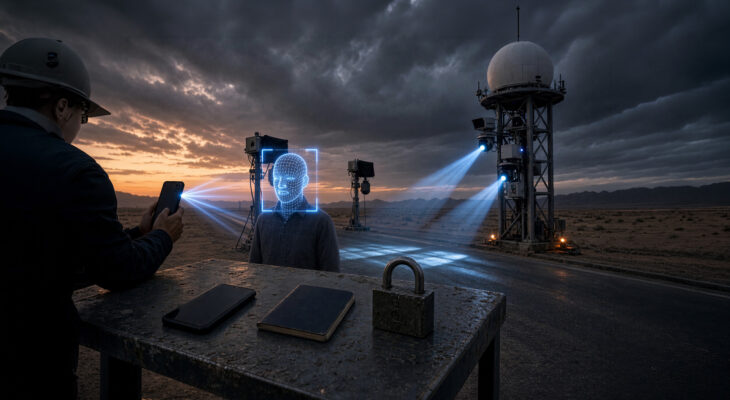
October put an AI surveillance tower on the American border road and a face-scan in a street stop. Meanwhile multiple towns cancelled their camera contracts. In Europe the scanning of private chats did not die and in India they’ll tie your messenger to a live SIM, while Mexico is already tying the SIM to a name.
These are not isolated developments. They are the shape of things to come if we don’t push back.
I have defended privacy and security for decades. The global pattern is the same one my family left behind: a private life treated as a police matter, but now with AI and better cameras.
What is being done to you is not border security. It is not child protection. It is not public safety. It is contempt for your movement, your face, your correspondence, and the very idea that “the state must justify itself before it searches you.“
Jump To Section:
- North America
- European Union and Britain
- The SIM that names the account
- What this does to you
- Practical steps you can take
- The Public Warning…
If you want the device setups and border kit behind these steps, plus a weekday briefing on what moved, you can join The Rekindled, starting free as a Seeker.
North America: Border AI Towers, Face-Scan Stops, and Cancelled Camera Contracts
United States: AI surveillance towers on the border
On 22 October the New York Times mapped what Customs calls the Smart Wall. The agency already runs at least 350 AI towers along the border. The paper located 209 of them and found about 180,000 people in the United States and 850,000 in Mexico living inside their view. More than a million in total. Four million more live inside the range of the older cameras Washington plans to retrofit. The administration has also allocated more than a billion dollars for 1,500 new towers.
The stated goal is full coverage of the Mexican border, then Canada, the coasts, and Puerto Rico.
CBP says the towers do not scan faces. What they do do is radar, day-and-night cameras, and an onboard computer that keeps watching the road at all times.
A human operator blinks, looks away, and gets tired. The computer does not.
The gathered data sits on government servers for an undisclosed amount of time.
If you live near that line, the “secondary scan” is no longer a windowless room and no longer an airport arch. It is a mast. You do not even have to cross any border. You only have to drive the road the tower can see you.
Facial recognition on DHS street stops
The Department of Homeland Security publishes a list of the AI tools it uses. That list is supposed to tell the public what the tools do and how they are watched.
Someone read that list this month. It does not say the important part out loud.
It does not say that ICE and Customs have a phone app called Mobile Fortify that scans a face. It does not say agents have been told that if the app matches a face, they can treat the match as the final answer, even if the person shows a birth certificate that says otherwise. It does not say the page that was supposed to explain how the app is checked for abuse has been taken down.
When the department was asked if anyone is watching the app for harm to people’s rights, it ticked a box that says yes. That is all. No explanation. No public webpage. Just a tick.
Court filings earlier this year put the app at more than 100,000 deployments in its first six months, including on people who are not the target. A false match can mean a wrongful arrest. A true match of a citizen who happened to be standing there can still sit in a federal biometric pile for years.
You do not have to be an illegal immigrant to get “tagged.” You only have to be in front of the agent’s phone.
ICE’s next order is ERO ONE: a $100 million programme to hire 142 cleared analysts to map relationships. The solicitation is expected in December. That is software that takes the people around you (a neighbour, a lawyer, a clinic) and draws the lines between them, so the agency can see who knows whom.
Palantir is the company building the system. France’s domestic intelligence service and Germany’s have already stopped using Palantir, because US law can force a US company to hand over data even when the data sits outside the United States.
Meanwhile the American government has not stopped using it. In fact its use is being expanded.
Towns cancelling Flock camera contracts
At the “good news” end of t he scale, the local rollback on Flock is real. Midland, Texas voted unanimously on 13 October to end a contract covering 71 fixed cameras, and avoided a second-year bill of about $225,000. Lafayette, Colorado is terminating its contract early and covering the lenses until they come down. Amelia County, Virginia ended its contract on 15 October. Baraboo, Wisconsin will not continue its pilot.
A tracker compiled from DeFlock now lists on the order of 370 communities that have cancelled, paused, or refused.
October is the rare month where town councils did their job.
But that’s only half the story. Cato’s note of 6 October is the other half: Flock’s software can already pick out a driver by the pattern of their drive, and surface “associates” from cars that pass together. The pole your council voted down is also not the only pole. September’s teardown still stands. One unit in three weeks recorded about 50,200 vehicles and took 1.6 million images, sitting on an unlocked part of the drive Worse still, the software that scores people and bicycles has a nationally-available search box that accepted “LMAO” as a reason to run a search on people.
If your town still rents the pole, that is your fight, and October showed it can be won.
In other news, customs searched more than 55,000 electronic devices in the 2025 fiscal year. Data retention on that border database is 15 years.
This unambiguously means that a border crossing is “consent to open your life to the powers that be.“
European Union and Britain: Chat Control still in Force, and the Online Safety Invoice
Chat Control is the European half of the same design.
Chat Control 1.0 is still live until April 2028. The 29 September trilogue blocked the European Council’s attempt to push broad “search plans” for private chats, and left behind a provisional deal on scanning publicly accessible content.
Private detection is still being negotiated. End-to-end encrypted chats are exempted from the current voluntary regime. That exemption is a fine line, not a victory.
India already binds the account to a SIM. Mexico ALREADY binds the SIM to a name while Europe is arguing over whether the content of a chat may be arbitrarily opened and scanned.
Put the three together and you have the finished system: A body attached to a number, a number attached to an account, and a legal claim on the contents.
In Britain Ofcom has now invoiced the companies it regulates under the Online Safety Act. Google, Meta, TikTok and X are among 45 firms billed for 2026/27. A company is on the list if it takes more than £250 million a year worldwide and more than £10 million of that in the UK.
This is not a fine. It is the bill for Ofcom’s own running costs, staff, rules, and checks on whether those same companies are removing the content the Act says they must remove.
The regulator is funded by the firms it is supposed to police. You pay for it in the price of the service. “Safety” is the slogan. The invoice is how the law is paid for.
The SIM that Names the Account
India is not a distant case. It is the blueprint.
The Department of Telecommunications has ordered messaging apps (WhatsApp, Telegram, Signal, Snapchat and others) to bind every account to a live SIM by 31 December 2026, with the rule biting from 1 January 2027. A chat app that works on Wi-Fi without the registered SIM, or on a second device, or for a traveller, is the thing they are closing.
The justification is fraud which, given India’s rampant global fraud problem, is not that far fetched. However, the real-world effect is that your messenger becomes a phone number the state can see.
Mexico is already running the same idea on the line itself.
Under the 2025 Telecommunications Law and the CRT guidelines of December 2025, a mobile line may be activated and kept only if it is tied to a named person, a CURP for an individual, an RFC for a company. Linking began on 9 January 2026. It is the third Mexican attempt to end anonymous telephony.
The current scheme was written around a prior Supreme Court ruling: carriers are forbidden to keep biometric data, photographs, or copies of identity documents, and the government says the subscriber file stays with the operator rather than in one state database. The original 30 June deadline was missed.
Fewer than half the lines were registered. The CRT replaced it with a staggered schedule by the last digit of the number, running through 31 December 2026, now aimed at prepaid lines. Unregistered lines are restricted until the owner presents identification. Beside this sits the biometric CURP (fingerprints and a face on the national identity) which is under legal challenge; in October the Supreme Court paused 145 amparos until it sets a criterion.
The direction, however, is the same everywhere. A phone number without an attached name is being treated as a surveillance blackspot to be closed.
What this does to You
If you live within sight of the southern border, a tower is already watching the road you drive. If an agent stops you inland, a phone may scan your face and the match may be treated as the end of the argument. If your town still rents a Flock pole, the September teardown still stands. If you use Facebook or Instagram in the settling US states, Meta has a year to age-check every account, and facial estimation is expressly allowed. If you message from India, the account is about to be chained to a SIM. If you carry a Mexican prepaid line, the SIM is being chained to a name.
These are not separate upgrades.
They are the parts of one finished system, and India is the clearest example of it.
- A tower sees the road.
- A phone at the stop names the face.
- A plate camera fills the gap between them.
- An age-check ties the social account to a body.
- A SIM-bind ties the messenger to a phone number.
- A CURP-bind ties the phone number to a person.
- Chat Control is the attempt to access private contents.
In the finished version you do not need a warrant for a stranger. You need a name, and the name is already on the line, and the line is already on the account, and the account is already being scanned.
The United States and Europe are not there yet. They are collecting the pieces. “Your Compliance” is how they will finish the job.
Practical Steps You can Take
These are written for readers who are not technicians. Do the first three this week. Do the rest as you can.
Find out if your town rents the pole. Search your city or county name with “Flock” and “licence plate.” Check the DeFlock map above. If the contract is live, the October pattern is the one that worked to end it: a resident shows up, asks who can search the national pool, asks how long the images are kept, and asks the council to end it. Midland, Lafayette, Amelia County and Baraboo did not need a new law to kick Flock out.
They needed a vote. If you cannot attend, send the question in writing and ask for it to be read into the record.
Cross a border with a device that holds nothing you cannot rebuild. Before you fly or drive through an international crossing, move photos, messages and documents off the phone you are carrying. A cheap second handset, restored from a backup after you clear immigration, is the practical answer to a state that has announced it will open the device. Do not rely on a passcode alone. Customs searched more than 55,000 devices last fiscal year and keeps the data for 15 years.
If you are stopped inland and a phone is pointed at your face, do not help. You are not required to unlock a personal device for a street stop. Ask if you are free to leave. Ask for a lawyer if you are not. Do not consent to a search of the phone. A Mobile Fortify match is not a court order, whatever an agent has been told. Write down the time, the place, and the agency as soon as you can.
False matches have already produced wrongful stops. Your notes are the record they would rather you did not keep.
Move the conversations that matter off the default chat. Install Signal or something even more secure, for the conversations that cannot stay on WhatsApp or SMS. In the settings, turn on registration lock, set a PIN, and check Linked Devices. Remove any you do not recognise. That last step matters because police in Germany have already cloned WhatsApp, Signal and Telegram accounts by adding a linked device.
Then understand the limit. Signal still runs through Signal’s servers. The company can be ordered, hacked, or simply change its policies. True private communication does not sit on someone else’s machine. It is peer to peer: the two devices talk to each other, and no third party holds the message or the metadata. Session, Briar, and a self-hosted Matrix room are the practical steps in that direction.
Stop feeding the age-check and the ad. If Meta prompts you to prove your age, a government ID is the most you can hand over and the least you should. Facial age estimation is expressly permitted in the US settlement. Use a separate account for anything you would not want tied to a passport scan.
On the browser, install a content blocker. The spyware that used to need a government contract now rides ordinary ads. Do not tap a banner. Do not install a “VPN” from an app-store advert.
Harden the phone you actually carry. Unique passphrases, stored in a manager or a notebook you control, not reused. Two-factor authentication that is not a text message: an authenticator app, or a hardware key if you have one. GrapheneOS on a Pixel you control is the serious option; the setup is a weekend, not a doctorate, and the Arsenal walks it step by step. Turn off location history. Review which apps can see your camera, microphone and contacts, and revoke the ones that have no business there.
Compartmentalise. One identity for the bank and the government. Another for the forums and the causes. Do not let the plate reader, the shop camera and the social account stitch you into one file because you used the same email everywhere. A separate browser profile costs nothing.
The Public Warning, and the Membership
This piece is the charge sheet. It is not the remedial workshop. The device setups, the GrapheneOS path, the border kit, the browser hardening, and the weekday Digital Freedom briefing that tells you what moved in the last twenty-four hours live with The Rekindled membership.
Seer is USD $35 a year if you join before 31 March 2027, and that rate locks for as long as you stay. You get the Arsenal (Mental, Digital, Economic, Strategic) the three weekday briefings, and a monthly picture of what held and what moved.
Sage, at the introductory rate is USD $120 a year and adds the weekly strategic and economic reports/predictions, a monthly members’ call, and occasional crypto updates and tips. After March the prices rise. The rate you join at is the rate you renew at.
Join The Rekindled or start as a Seeker, free, and take the Threat Level Assessment so you know which of these steps is urgent for you.
Remember: Compliance is how they finish the job.
A town voted the pole camera down this month. That is the proof the vote still works, at least locally. Use it.
What on this list concerns you most? The mast, the stop, the pole, the SIM, the age-check? Tell me. I read what you send.
Stay sovereign and stay informed.