
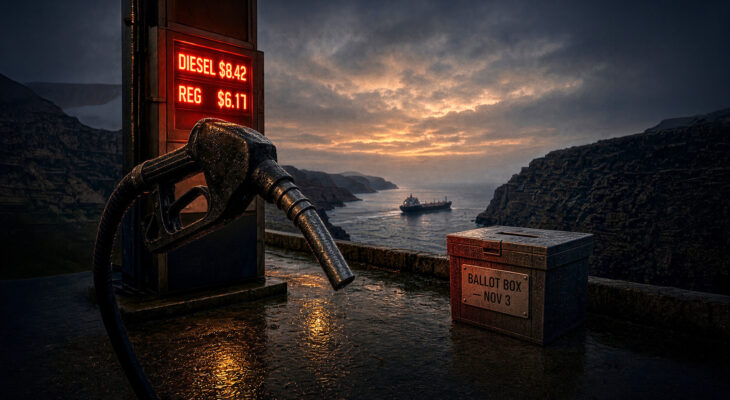
Diesel is already at a record. Food is next. Last week two oil valves closed. This week Washington spun up a strike on Yemen and canceled it before the weekend. As predicted, your higher bill is already on the pump; the aborted strike tells you why.
I do not treat mid-September as just another Houthi raid that spilled over. I treat it as the moment a crucial logistics workaround died. Hormuz has been Middle East oil’s “east door,” already choked for most of 2026. The East–West pipeline to Yanbu, with tankers down the Red Sea from there, was the “west door.” That door just closed.
Jump To Section:
- So What Happened?
- Not Just A Yemen Story
- A Kingdom Boxed In On 3 Sides
- The Package That Didn’t Fly
- Already In The Price
- The Midterm Clock Is Ticking
- What You Can Do
So What Happened?
Ansar Allah, the Houthi movement that already governed much of northern Yemen, took the port of Mocha and the islands inside Bab al-Mandab, including Perim.
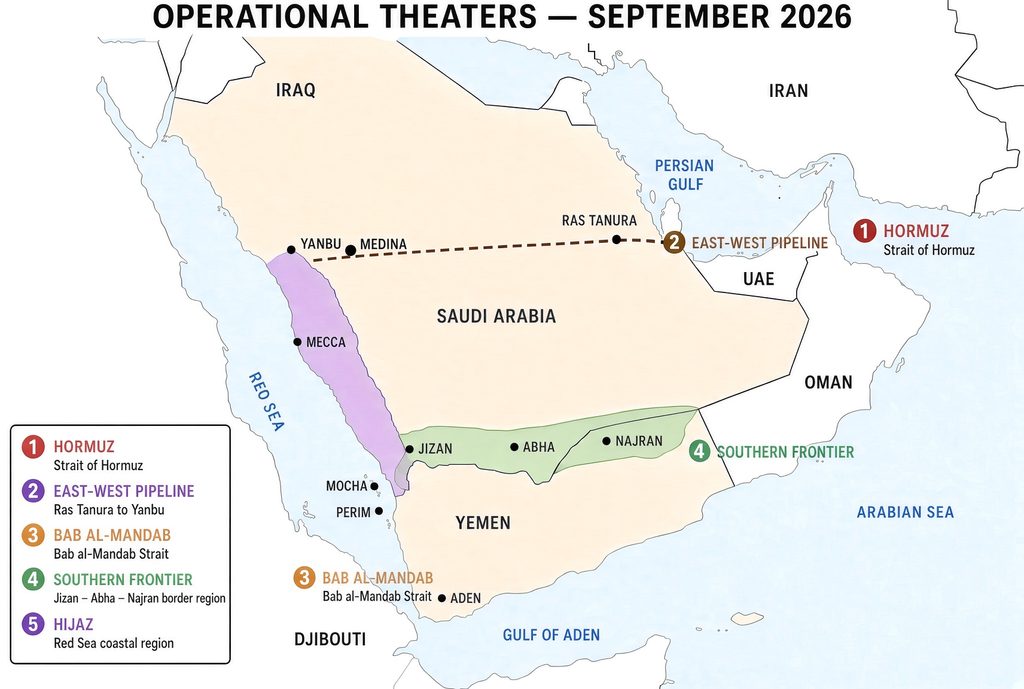
The shipping lane there isn’t wide, it’s basically a pinch, and whoever sits on Perim and the heights above can refuse to let a hull pass.
That is a solid shipping veto, not just battlefield bragging rights.
On 10–11 September, drones launched from Iraqi territory also hit pumping stations on the East–West pipeline. Open reporting puts the line out of action. Repair talk is measured in weeks, if parts arrive in a timely way. Yanbu now only loads what is already in its tanks, and those tanks hold days of supply, not months. When they drain, the barrels do not sail unless the pipe is fixed or another route opens.
That, ladies and gents, is missing oil supply, not just a localized Houthi success.
Brent ran near 110 mid-week and eased toward 103–104 on 18 September on workaround talk and deal hints. I read the dip as traders selling the spike, not as actual price relief. Relief would be tankers loading again at Yanbu, or Hormuz volumes actually returning.
Talk about workarounds and deals does not equate to moving barrels.
Not Just A Yemen Story
The media frame is a militia that got lucky after a raid on its leaders. However, energy contacts in the Gulf were warning in late June that Ansar Allah was preparing to take the southwest coast. In September it took Mocha and then Perim within hours. Saudi-backed units in the region then folded in days. That is a campaign built over months, not a surprise raid.
Ansar Allah is fighting more than one war with the same units:
- A border quarrel older than 1979 that still runs through land Britain arbitrarily assigned to Riyadh in 1934
- A campaign against the U.S.–Israeli war architecture.
Iran supplies parts and cover. Iran DOES NOT control the conflict with a joystick in Tehran.
Seven years of surviving a Saudi air war, then a blockade of Saudi-flagged ships from 20 July, then a successful ground offensive on their own timetable… This demonstrates Houthi independence without needing a secret briefing.
The economic meaning is simpler than the conflict theology. After Hormuz tightened, the 1,200-kilometre line to Yanbu was the last remaining large oil valve. Then Saudi-flagged tankers were barred from the Red Sea. Loadings fell. And then the pipe was hit, from Iraq, not from Sanaa.
Same coordinated pressure. Different patch on the shooters.
A Kingdom Boxed On Three Sides
East: Hormuz.
West: the pipeline and Yanbu.
South: Bab al-Mandab and a force sitting on the 1934 claim.
Fighting is still live on the heights that look down on the Bab al-Mandab strait. Those heights matter far more than a ministry building in Aden. Artillery on that ridge can cover the shipping lane without firing an expensive ballistic missile.
Saudi Arabia’s Vision 2030, the stipends that keep rival tribes quiet, and the cash that keeps a very large royal family from splintering all sit on the country’s oil export volumes.
Cut those volumes long enough and this stops being a foreign-policy problem. It becomes a regime-maintenance problem.
I will not say the House of Saud falls this winter. Collapse is four futures stacked into one word.
However, the sequence already in motion is simpler: projects slip, the factions have to be paid, the crown prince keeps the title and loses autonomy.
Unofficial economic channels now say contracts and network stipends are already late, that Vision-class projects spent the easy cash, and that Gulf allies take Saudi paper only at a discount. I have not seen an audited payroll. I treat the sequence as events happening in the present tense, not as a defined “collapse” flag coming down.
What’s more, bombing does not reopen a pipeline.
Saudi airpower spent years failing to break Ansar Allah.
And an air campaign that does not retake Mocha and Perim is just theater, while a ground campaign to retake them requires someone else’s infantry, simply because it’s beyond the Saudi military’s capabilities.
That is why Riyadh went to Islamabad and Ankara for “assurances.” Pakistan publicly said it will defend Saudi Arabia “to any extent”. I read that as a shield over the holy sites and the Saudi airbases. I do not read it as Pakistani brigades dying in the Tihama for quarrel about a British border marker from 1934. The August pact signed in Mecca is paper. It is not a plan to restore Mocha.
The Package That Didn’t Fly
On Thursday evening Trump ordered the military to prepare a strike on Houthi positions in Yemen. On Sunday morning he canceled it.
I treat that as intent and abort… not as a completed raid.
Military sources give the reason the map already showed: there is simply no target set that retakes Mocha and Perim. Ansar Allah is light, mobile, and on the high ground. A U.S. hit would be answered by further pressure on Saudi energy, not with the coast handed back to Riyadh.
U.S. diesel was already at successive national records. Those same sources put a Yemen strike-package as a direct path to a much higher average price before 3 November.
The abort is also a message inside Riyadh. Mohammed bin Salman’s security story was that the White House was his insurance. The Thursday–Sunday “intent-abort” sequence told every rival in his family that the insurance will not pay on this claim.
However, it’s simply constriction on his autocratice rule. It’s not a revolution afternoon toppling him.
Already In The Price
U.S. diesel already set successive national records. California is far higher than the national average. Jet fuel is the second shock.
Most people feel the consequences of what’s happening in Saudi Arabia as higher pump prices and airfares, not as a price-ticker.
Face it: The entire Atlantic world has lost, for weeks and maybe months, the last land bridge that was substituting for Hormuz.
Industry tracking after the strike put millions of barrels a day at risk if the pipeline stays dark. Europe is being told it may miss the September Saudi allocation and probably October too. Some barrels have come back through ship-to-ship transfers near Oman, from tanks being drawn down, from extra Russian and U.S. crude, and from people simply using less.
But not all of them. Diesel and jet supply does not reset because of a press release.
Hiring a giant tanker from the Gulf to China already takes a double-digit slice of the delivered barrel. As always, Asia pays it first. Europe and North America pay it later on the pump and the air ticket.
IMPORTANT: That price-lag is why a deal headline next week WILL NOT save November’s election being decided on sky-high gas prices. He who owns the war owns the pump prices, and Yanbu was already thin before the line was hit.
On 16 September the Federal Reserve raised rates a quarter point (the first hike in three years) straight into a supply shock. Households now pay more for fuel and more for credit in the same week. I call that a SERIOUS policy-error risk. I also call it the election. The Yemen strike-abort was the pump winning an argument the war room lost.
It does not mean another strike-package cannot be rebuilt after the vote. It means this White House can see the diesel price attached to that choice.
The Midterm Clock Is Ticking
November 3rd is the American clock.
Refined fuel lags crude by four to eight weeks. A pipeline that comes back in late October will not put cheap diesel in Midwestern tanks before people vote. A corridor announced next week doesn’t either.
I cannot prove that Tehran and Beijing intend to wait out the midterms. I can, however, see the incentive. As I said above: Own the war, own the pump.
Europe’s clock is winter.
Drought, no cheap Russian fertilizer, diesel in the tractor and the ship, they’re on the same bill as this oil shock. The European Union cannot rearm, replace Russian fuel, and pay wartime freight without households losing purchasing power.
Food moves first. Protests move next. This week European governments put the shortage on paper: Germany advanced conscription, Britain told households to prepare stores, jet fuel looks short by about half a million barrels in the fourth quarter, and truckers have queued for fuel in parts of France. Ukraine has lost enough warehouses and power that even more civilians will now try to reach Poland.
European Households will feel food and heat this winter long before the politics catch up.
In the Gulf region the political quiet was purchased with cheap energy and public-sector jobs. Remove both those legs and that purchase expires instantly. Sentiment, too, has changed. The monarchies no longer perceive an American war with Iran as a shield. They experience it as a direct tax on their own export routes.
Saudi Arabia was also the pivot for a Gulf-states normalization bet with Israel. And a regime that cannot export its oil is a poor foundation for that bet.
I merely note the stakes here. I do not write Israel’s next move. though I could venture a guess, based on its past track record.
China pays the freight and can wait.
Russia sells crude at a wartime price while the refined-product shortage is felt in the Atlantic, but not in Moscow.
India buys the cheapest barrel.
Australia and Japan pay more for gas and diesel while discovering that grand speeches about open seas do not sail a tanker to their shores through a closed strait.
To be clear: Ansar Allah has not toppled the House of Saud.
It closed the last large valve that let Riyadh pretend Hormuz didn’t matter. A long-standing monarchy that buys its quiet life with oil export cash is now short on cash. Kingdoms come apart that way across a season of constriction, not on a single afternoon.
I price the base case as persistently high diesel in the Atlantic world, a Saudi state cutting projects and talking to people it spent a decade isolating, and an American midterm held under a hostile pump sign.
The strike abort is data. Constriction is current. Collapse is the potential. Watch loadings, not speeches. The grocery ticket will not wait for a logistics map to catch up.
What You Can Do
Treat diesel, heating oil, and the grocery ticket as the signal, not the Sanaa-airport story. Rebuild a cash buffer before you buy a narrative. If you farm, haul, or heat with oil, lock what you can legally lock on a calendar, not on a panic Saturday. Book travel refundable. It’s called risk management…
The public brief stops at the household facts: two valves, a cancelled strike, diesel already on the ticket, winter costs arriving before the politics. The unabridged analysis: Sequence inside the kingdom, price paths, the thirty-day watch list, and a greatly expanded set of actions for North America and Europe is for Sage Tier members only.