Samuel Tunick already faces five years in a federal cage for giving Customs a GrapheneOS duress PIN instead of a device containing his readable life. Georgia State University has now finished the sentencing that the indictment itself only started. Six hours before his first Geosciences lab, an automated email told him he had failed a “background check.”
His Teaching Assistant post is gone. The tuition waiver tied to his Master’s is gone.
No conviction. No written policy.
A committee, a dean, and a lawyer performed a “risk assessment” on a man the state has not yet persuaded a jury to hate.
The border asked for the contents of a mind. The university asked whether employing the owner of that mind was safe.
Jump To Section:
So What Happened?
You already know the first half. Tunick came home through Atlanta in January 2025. An internal mail had already circulated his name and photograph under “suspected terrorism activities.” The publicly produced basis for that heading is association with the movement against Cop City, not a bomb, not a plot, just association.
In a windowless secondary inspection room he was ordered to open the phone. Instead of unlocking it he handed over the PIN that wipes the device.
The Department of Justice answered with 18 U.S.C. § 2232(a): destruction of property to prevent seizure. He has pleaded not guilty. Written argument on the motion to suppress ran through 18 September. The government answers on 9 October. His reply is due 23 October. A ruling is not expected before the end of October.
That was the state’s work.
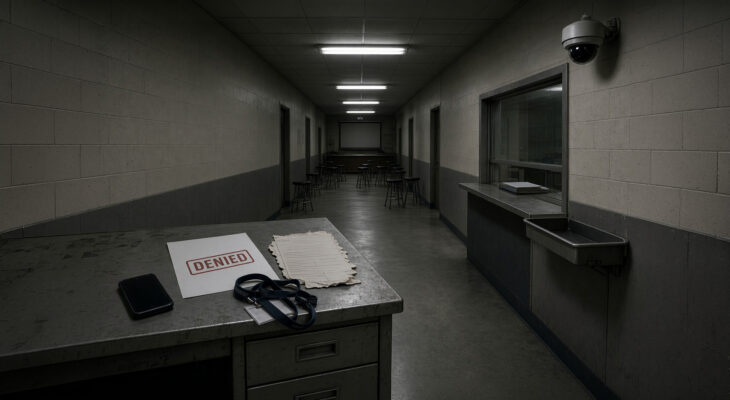
GSU’s work arrived in August. Tunick was due to run his first lab on 25 August. Six hours prior to the lab, the automated refusal arrived. Emails he has shared show the decision sat with a Background Check Committee, the Dean of Students, and the university legal department, each conducting a “risk assessment on a case-by-case basis.” His department head asked for the governing policy and was told, in substance, that there isn’t one. A Fulton County misdemeanour (later dismissed) was on the file.
Earlier this month Tunick and supporters handed GSU a demand letter. He called the indictment political repression; he is still waiting for a trial. The university’s reply was not a published rule. It was a closed-door “risk assessment” by a committee, a dean, and counsel, and a pending charge was enough to end the hire.
Read that again: The “pending” federal indictment was enough to end the hire.
FunFact: The same apparatus that marked him at the airport had already been in his daily life: vehicle tracking, record subpoenas, cameras pointed at a house. The campus email is not a separate story. It is the next station on the same line of consequneces for wrongthink.
The Sentence They Can Serve Before Trial
A pending charge is not a guilty verdict. A public university that treats it as one has volunteered to be the extra-judicial half of a border prosecution. No dean needs to break encryption. No counsel needs a warrant. They only need a “risk” tickbox and an automated mail.
The student who used a legal feature of a legal operating system becomes unemployable in the city where the case is being tried, which is also the city whose police training complex he opposed.
That is systemic design, whether or not anyone formally wrote it down.
GrapheneOS remains legal. Its authors have said so in terms the Constitution already supplied: they have no obligation to weaken the protections, and a law that forced them to would be unconstitutional.
The duress PIN exists because the developers understood that some demands cannot be safely refused.
The United States is attempting to make that understanding a felony. GSU has attempted to make it a career.
Article 12 of the Universal Declaration and Article 17 of the ICCPR still say a person’s correspondence is not a public resource. The Fourth Amendment still says a search needs a reason that can be shown to a judge, except at the border, where the courts have spent a decade teaching Customs Enforcers that “the Constitution waits outside.”
None of that required a university to enforce a punishment that had not yet been meted out. GSU enforced it anyway, and called it “due diligence.“
What This Means If You Are Not Samuel Tunick
It means the punishment for preserving you residual privacy is no longer confined to the dock.
Employers, registrars, landlords, and licensing boards can complete a case the state has not actuially won and dole out a punishment not yet issued.
A watchlist entry plus a pending count plus a “case-by-case risk assessment” is enough to close a door that no jury has been asked to close.
If you travel with a hardened device, assume the secondary room is only the first interview. The next will be an HR portal. If you work in a public institution, assume the legal department already knows how to read an indictment as a character reference. If you keep a duress PIN, assume someone will eventually frame it as an admission of guilt.
FunFact: BTF members already have the operational guidance this case was written to punish: GrapheneOS as a daily driver, a travel handset that holds nothing worth restoring, compartmentalised accounts, and the habit of treating a border as a hostile forensic lab.
That instruction is not theatre. It is the difference between a clean crossing and surrendering a readable life.
The response CANNOT be compliance to make yourself more employable to a committee that has no policy.
Keep the PIN. Keep the separate travel device. Keep the record of who decided, and on what authority. And do not confuse a university’s fear of a headline with a finding of guilt.
YOU HAVE BEEN WARNED!