
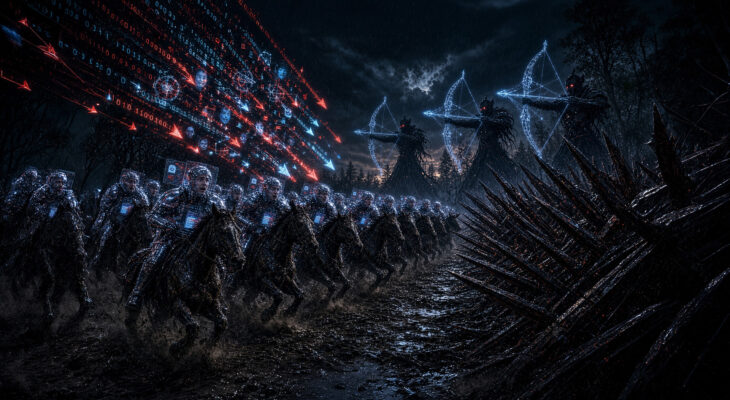
Although it’s not immediately obvious, the Battle of Agincourt on 25 October 1415, and the changes it forced onto every subsequent battlefield, is 100 percent analogous to the present condition of artificial intelligence and how it relates to your personal existence.
The parallel is not decorative. It is structural.
A significantly smaller force that had prepared the battle ground, mastered a high-volume offensive capability, and refused to abandon its position when charged defeated a larger force that still trusted traditional battlefield rules and status. Nobody in that larger French force needed to carry or use longbows in order to be destroyed by them.
Jump To Section:
- The Digital Battlefield’s Governing Logic
- The Condition Of Today’s Digital Arena
- The Architecture Is Not Accidental
- Removing The AI Mystery
- Arm Yourself
The Same Logic Governs The Digital Battlefield
Governmental and big tech platforms, data systems, and models have already prepared the ground against you to be tracked, traced, and judged every moment you’re online, and increasingly in real life too. You only need to look on the growing encroachment of Flock cameras on your privacy, to see that AI is following you almost constantly.
And there’s no need for you to ever open an AI prompt box to be priced, ranked, scored, or filtered by Artificial Intelligence algorithms. Indeed, treating avoidance of generative tools as “resistance” or “safety” is the same decision the French knights made when they advanced into known anti-cavalry defenses and mud, because their old advantages of massed force still “felt decisive.”
On that morning the field between the woods was narrow, freshly plowed, and soaked by recent rain. Henry V’s English force, roughly six to nine thousand men consisting mainly of trained longbowmen, had driven sharpened stakes into the ground at an angle in front of their thin line in order to break the coming charge by the French army.
The French, substantially larger and heavy with men-at-arms in plate-armor, faced a choice. They could wait and simply starve out the smaller English force or they could advance in the dense “invincible” formations they had relied on for centuries.
They Chose The Latter
Horses sank in the mud or panicked under the relentless English volleys. Men in heavy armor labored through the mire. As the leading ranks slowed, those behind pressed forward until the formation compressed and men could barely swing a weapon. Stakes broke the remaining mounted attacks. English men-at-arms finished what ground, stakes, rate of fire, and compression had already begun.
French losses ran into the thousands; English losses were but a few hundred.
The decisive fact was not that the French lacked courage or numbers. It was that they treated a field and tactics specifically prepared against them as if it were still a traditional combat zone on which sheer mass and force would decide the outcome.
That Is EXACTLY The Condition Of Today’s Digital Arena
The online platforms, data brokers, and scoring systems have already set the stakes against you and prepared the battle ground. The “mud” is the continuous accumulation of behavioral traces, like scroll depth, hover time, device fingerprint, purchase sequence, location traces, and the small hesitations that reveal your preference or anxiety, all of which are meticulously tracked by Amazon, Facebook, Google, X and any number of other online platforms.
The “narrow woods” are the ranking algorithms, identity systems, and platform rules that prevent any real flanking maneuver around the “essential” services you and most other people use for daily online life. If I had a Dollar for every time I’ve heard “I hate Facebook. I’m only on there because ALL my friends and family are.” those Dollars would be worth a lot less than they were before Trump started his lunacy in Iran.
And it’s ARTIFICIAL INTELLIGENCE, not Super Intelligence, you f*cking imbecile.
But I digress…
AI models controlling that ground do not wait for you to open a chat window. They operate on the data already generated by your everyday use.
- Dynamic pricing adjusts according to your inferred willingness to pay.
- Automated risk scores flag your applications or claims.
- Content ranking algorithms decide which stories reach you and which are throttled.
- Synthetic material floods your feeds.
Newsflash: Your passive avoidance of AI will not clear away its stakes.
It simply guarantees the compression used against you and other ordinary humans continues… higher prices for some, lower visibility for others, tighter conditions for credit, platform access, and insurance claims, while the average normie still blissfully believes that non-participation in AI keeps them outside the killing zone.
The Architecture Is Not Accidental
Concentrated compute-power and proprietary data pipelines give big tech platforms the same kind of prepared position the English held: High volume of effect, continuous observation of the normie advance, and the ability to update the aiming trajectory while the other side is still moving.
Declining to use AI tools yourself does not dismantle any of this. It leaves the only skilled combatants on the other side of the stakes.
Learn Or Perish
Learning to use AI effectively is becoming a crucial self-defense and survival skill for the same reason the English trained yeomen from youth and carefully prepared the ground before the larger, more heavily armed force ever appeared.
Make no mistake, I’m not claiming that your personal models will defeat big tech’s gargantuan platforms.
My claim is far more specific: Your deliberate AI capability reduces the compression on your life and restores your measurable options.
A capable model used right can surface parasitic clauses in the tedious, longwinded privacy policy and terms of service of the platforms you already rely on, extracting the data-sharing parameters, retention periods, and third-party transfers that matter from the bloviated legalese and the marketing language.
FunFact: I once read through Facebook’s privacy policy and terms of service… Scary as hell. It took me nearly six hours. No normal human has time for that, yet everyone cheerfully clicks “I Agree.“
But in any case, AI can map a major data-broker exposure of your life from public records and purchase histories, then draft the extremely precise removal or correction request that the data-broker’s own takedown form is designed to frustrate if a human attempts to make that request.
The same capability surfaces patterns in your own digital trail, like repeated queries, location clusters, or purchase sequences that are being exploited, which would otherwise remain invisible until your score or your price changes, based on your perceived “desperation” by the machine.
Direct Interaction With AI Removes The Mystery
Personally watching an AI model invent details, compress nuance, or amplify a slant makes the mechanisms of synthetic persuasion and automated ranking more evident.
What was previously treated as an invincible, opaque force majeure becomes a set of predictable failure modes once its mechanisms are visible to you.
You become harder to influence with AI-generated social engineering or deepfake material because you have seen how that output is produced.
Personal workflows turn the same leverage the platforms use against individuals into friction against them:
- Automated drafting of legal or administrative responses to account freezes, data requests, or insurance disputes increases the effectiveness and reduces the time cost of your resistance.
- Personalized filtering layers can be applied to incoming feeds or alerts so that algorithmic ranking systems no longer control your information diet.
- Code or scripts that run locally can automate routine data-hygiene tasks or monitor for unexpected changes in platform permissions.
None of these steps require frontier-scale AI models or institutional resources. They require your AI literacy and the habit of treating the available tools as instruments rather than demonic obstacles. That literacy sits inside the Keys to Freedom.
Digital device and account control limits what new data is generated about you in the first place.
Economic self-custody reduces the leverage of any single institution or scored service against you.
Mental habits that resist manufactured urgency keep ranking systems from defining what feels urgent to you.
Strategic awareness of how identity, payments, and content systems are being linked keeps your individual response from becoming purely reactive.
Weakness in one Key limits the rest.
Arm Yourself
Capable AI use reinforces the keys by making the pressures against you visible and contestable rather than ambient and obscure.
The French commanders at Agincourt were not ignorant of English tactics. They had plans that included mounted attempts against the archers. Those plans failed on the actual ground.
A much larger French force still advanced into the positions prepared against it because the alternative (refusing the field or dispersing) felt like the surrender of the traditional tactics it still trusted.
That same mindset is now common with many people. Continuing ordinary platform use while willfully declining the artificial intelligence tools that make their control systems legible is treated as the conservative, common sense choice.
It is the predictable en-masse charge by the normies that has already been factored and prepared against.
The battlefield is narrow.
The stakes are set against you.
What will you do?
This technological evolution is an arms race, just as it was at Agincourt. Even while the longbow still dominated that field, the next weapon system was already present, and already killing.
Contemporary records note that an English archer, Roger Hunt, was killed at the battle “cum uno gune…” by a gun. French hand cannons or small firearms, still crude and unreliable, were deployed at Agincourt.
Their effect that day was limited compared with the arrow storm, yet the presence of a recorded death by gunpowder weapon on the same field where the longbow fundamentally changed the nature of warfare marks the start of the next shift. Armies that continued to treat the longbow as the final form of missile power, or that refused to factor and adopt the emerging alternative, faced the same compression and wholesale slaughter later, when field artillery and hand firearms superseded archery as the deciding factor.
The forces that adapted early retained options. The ones that treated the previous advantage as permanent did not.
The only durable response is the one that worked after the larger force discovered the prepared ground too late: Train the rate of fire you can actually control, set what defenses remain available, and stop treating the old formation as if the mud and the stakes set against you were optional.
This arms race will not pause for spectators.