
IMPORTANT: This will affect you, even if you don’t live in Europe.
Britain calls it defense. We call it “a seat at a table that’s already being cleared.”
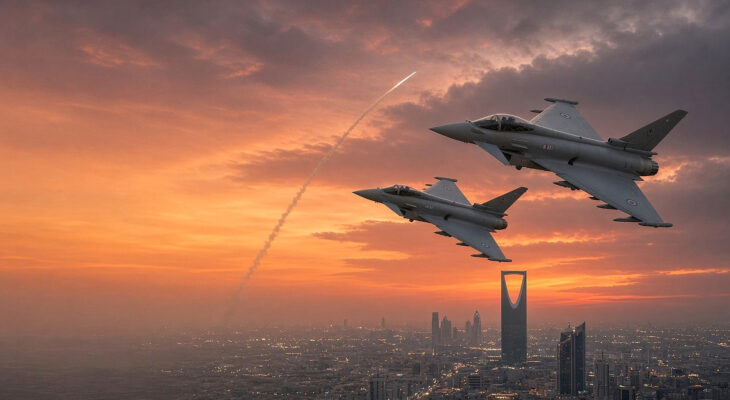
Today the UK Ministry of Defense announced that Royal Air Force (RAF) Typhoon fighters will fly “defensive counter air missions” over Saudi Arabia, plus a transport aircraft, military advisers, and extra air-to-air refueling for Saudi air operations, including those “to degrade Houthi military targets in Yemen” (GOV.UK).
The same day, Emmanuel Macron (President of France) closed his Gulf tour with diesel commitments covering just over 10% of what France burns (France 24). Brent crude touched $111.05, its highest since May (CNBC).
A European air force is now flying inside an active war outside its boundaries.
The real question is what Europe gets for it, and what it will cost you, even if you don’t live in Europe.
Jump To Section:
- What Actually Happened
- The War Europe Is Joining
- The Allies Who Are Not Coming
- The Bill Comes Home
- Where This Goes From Here
- What This Means For You
- There’s A Lot More To This
Members get the full picture every morning: three weekdaily briefings on digital, strategic and economic freedom, built from primary data and written so you can act before the headlines catch up. Join the Rekindled today.
What Actually Happened
Yemen’s Houthi movement, known formally as Ansar Allah, has spent weeks hitting Saudi Arabia with missiles and drones: Riyadh’s airport, oil sites, and the kingdom’s proxies inside Yemen. Saudi forces shot down another ballistic missile aimed at Riyadh this morning (Al Arabiya).
Riyadh also postponed its flagship Future Investment Initiative (FII) conference to 2027 (CNBC). Air France and KLM have suspended Riyadh flights to 7 November, Lufthansa to 18 November (Reuters via Investing.com). Meanwhile Egypt’s parliament has pushed its vote on military support for Saudi Arabia back to 26 October (Al Jazeera).
London insists its jets “will not conduct offensive strikes against the Houthis.” But let’s be frank; refueling the aircraft that do strike Yemen is “participation in offensive strikes,” by any honest definition.
The ministry itself also stated that the fighting is “driving up the cost of living” in Britain.
That is the OFFICIAL frame: Defend a partner, protect the oil, calm the pump.
The War Europe Is Joining
Having tracked this war closely we see the situation very differently. What follows is analytical forecasting, not confirmed intelligence, but it needs to be taken seriously.
Europe is not backing a winner. Several highly credible military analysts who follow the Yemen front daily judge the Saudi crown prince to be in a very fragile position, and doubt that Washington or anyone else will be able to rescue him. They argue that Ansar Allah has brought Saudi Arabia close to collapse, and that the kingdom’s own neighbors increasingly treat its decline as “a matter of time” rather than a mere possibility.
OS-Intel also clearly highlights the Saudi kingdom’s real weak point: Its oil assets cannot be protected. If Yemen decides to hit those installations harder, the Saudi government could indeed fall quickly, because its stability depends almost entirely on those exports.
And British air defense over Riyadh does nothing to prevent that fall.
Typhoons can intercept a missile over a city. They cannot guard 1,200 kilometers of pipeline from the eastern fields to Yanbu, which has already been shut once, from 11 to 22 September (AFP via TBS).
Military sources add that the Houthis have done more damage to Saudi forces and infrastructure in three weeks than in all their previous wars with the kingdom.
They also name a critical structural flaw: When Mohammed bin Salman (Saudi Crown Prince, MBS) centralized power in 2017, he made himself a single point of failure.
Remove him and the existing Saudi state structure goes with him.
A look at history might also explain why Britain’s return to the region matters. For most of the 20th century, Britain was the dominant outside power in the Persian Gulf. It protected the small Gulf monarchies through treaties and military bases until it pulled out in 1971. The United States then took over that role, largely to keep Gulf oil flowing to world markets.
The Gulf’s ruling families have depended on that outside protection ever since. If the current order starts to collapse, Washington and London are no longer likely to come to the rescue. Instead, they’ll more probably step back and simply let the ruling elites fall.
Read that against today’s GOV.UK release. Britain is returning to the job it held a century ago, just as the regional structure it is defending it starting to show serious cracks.
The Allies Who Are Not Coming
Europe’s move matters more because Riyadh’s Muslim allies are openly hedging. Military sources with contacts in Islamabad say Pakistan will not take offensive action against Ansar Allah and will confine itself to guarding Mecca and Medina.
Others go even further: They see Pakistani and Turkish deployments as purely symbolic, and do not expect either country’s soldiers being sent to die for the Saudi crown.
Meanwhile Cairo stands to lose more than anyone by even talking about joining the Saudi/Yemeni fight.
In the 1960s, Egypt sent tens of thousands of troops to Yemen to back one side of a civil war there. The campaign dragged on for years, drained Egypt’s army and its treasury, and left the country badly stretched when Israel struck in June 1967.
As a direct result Egypt lost the Sinai Peninsula in six days, a defeat many historians blame at least partially on the Yemen war. Now, sixty years later, Cairo risks walking into the same trap again.
OSINT check: The open record supports this. Egypt has delayed its vote rather than rushed it, and Pakistan’s reported role is reconnaissance and support, not combat.
If the regional allies stay on the sidelines, the Western partners willing to fly become the backbone of Saudi air defense.
That is how a “defensive” mission quietly becomes a long one.
The Bill Comes Home On Both Sides Of The Atlantic
Here the analysis and the price data line up exactly.
Military sources trace how the Gulf cutoff starved the refineries that make diesel, and how Europe, having cut itself off from Russian supply, now bids against everyone else for what is left. And voters in both America and Europe, who care little about the war itself, care a great deal about what diesel costs.
The Receipts:
- AAA’s U.S. diesel average is $6.32 a gallon, about 21 cents below the record (AAA).
- France’s 10-year borrowing cost rose to about 4.97%, with its gap over Germany widening to about 153 basis points (hundredths of a percentage point) (MarketWatch). Moody’s reviews France on 23 October.
- Italy is sending 500 soldiers to Milan after weekend cost-of-living riots, with weekly Saturday marches planned (Guardian).
Following more than a decade of mass migration and internal bickering, Europe, for the first time in its modern history, is becoming marginal to world affairs. An entire continent buying diesel by contract while lending its jets to a kingdom under fire is exactly what that looks like in practice.
The consequences are circular. European jets defend Saudi oil, the war around that oil drives up European fuel prices, and those prices fill European streets with protesters.
And if you’re American, wipe that smug smile off your face, because you’re looking at the shape of things to come. The consequences of this failing Saudi conflict, and of the potential fall of the country’s ruling family will not stay confined to its own side of the Atlantic. In fact, the spillover from such an event will be disastrous for the entire global economy.
Where This Goes From Here
The probable path looks like this:
- Mission creep. Defensive patrols and refueling become the permanent base of Saudi air defense, because the regional allies will not step in to carry it.
- European assets become targets. It’s no great secret that Iran and its partners have strong surveillance across the region, covering American and European interests in the Gulf states. Bases hosting British jets now enter that strategic picture.
- The pipeline, not the capital, decides the outcome. If strikes on Saudi oil escalate, as we expect, prices move up regardless of how many missiles are intercepted.
- Politics at home harden. Expect more troops on streets in Europe, and increasing unrest on America’s streets. The result everywhere will be wider, harsher police powers, and more pressure on governments that are already weak in the polls.
- A political ending neither Europe nor America controls. It’s not a stretch to expect the war to end with MBS removed and China brokering new talks. If that happens, Europe will have paid for a seat at an empty table, with no say in the long-term outcome.
We cannot predict whether Britain’s role stays defensive or whether Egypt votes “yes” to entering the conflict on 26 October. But the direction things are taking matches the prices you are already paying.
And that price-tag isn’t likely to get smaller anytime soon…
What This Means For You
None of this is financial advice. It is household planning.
- Budget for $6-plus diesel and high heating oil through winter. Lock a fixed heating price now if your supplier still offers one.
- Treat Gulf travel as disrupted into November. Keep every leg on one ticket, and check the airline’s own page.
- In France or Italy, plan around Saturday marches. Stay out of city centers on Saturday afternoons and book refundable rail and hotels.
- Watch three dates: Egypt’s vote on 26 October, Moody’s on France on 23 October, and any British statement that drops the word “defensive.”
- Build a buffer that does not depend on calm in the Gulf. Ninety days of staples, medications, and cash outside your daily account.
A word to the wise, is all…
This Rapid Signal is educational analysis for readers of BackToFreedom.co. The forecasts above are informed predictions, not confirmed intelligence. None of this is financial, legal, or investment advice.
There’s A Lot More To This
This Rapid Signal is the public layer. The full picture, including how this war feeds the push for programmable money and controlled fuel, is in the members’ briefings.
The Rekindled is the membership that turns this information into a working kit: The Arsenal across Economic, Strategic, Digital, and Mental Freedom.