The predicted inflation shock is no longer a forecast. It’s at the pump, in the freight lane, and on Friday’s CPI calendar.
Over the past forty-eight hours the Strait of Hormuz stopped being a paused conflict and went back to being a shooting gallery. U.S. forces struck three Iranian tankers after IRGC ballistic missiles were launched at two U.S. Navy ships. Tehran answered by preparing a restricted zone outside the Strait, on top of the naval squeeze already in place. As a direct result Brent pushed into the mid-to-high $90s, WTI near $92, after a roughly 10 percent climb last week. U.S. regular gasoline printed a Labor Day record near $4.14 a gallon. Diesel, the blood of freight, is already at multi-year highs.
Hormuz commodity traffic has already slumped to its lowest 10-day average since May, about 10 ships a day, with only two transits on Saturday. As a direct result Brent pushed into the mid-to-high $90s, WTI near $92–$93, after a roughly 10 percent climb last week. U.S. regular gasoline reached a Labor Day record near $4.14–$4.15 a gallon, while Diesel hit an all-time national high around $5.85–$5.90.
Jump To Section:
- We Tried To Tell You
- What Actually Happened
- We Called It
- Where This Goes From Here
- What Ordinary People Can Still Do
- The Signal, Laid Bare
- There’s A Lot More To This
We Tried To Tell You
Not in milquetoast “tensions may rise” language. In March, August, and again eight days ago, our team mapped the inflationary transmission belt:
Hormuz risk premium → crude → gasoline and diesel → fertilizer and shipping insurance → the kitchen table.
The official story this morning is of course “renewed hostilities” and a “watchful Fed.” However, the real story is that the Post-Hormuz price regime we described is arriving in your household cash flow while Washington still needs a “quiet-enough Gulf” for the midterm election calendar.
Ok, so this is not the $190–$270 level we flagged as a tail in March, but it’s wise not to wait for that cartoon number before you start to act act.
The inflation shock does not require a $200 barrel. It requires a “stuck” risk premium in a chokepoint that still moves on the order of twenty million barrels a day.
That is what just re-priced.
What Actually Happened in 48 Hours
After a stretch of relative calm, fire resumed in the Gulf. Washington hit Iranian crude carriers. Tehran fired on U.S. warships and telegraphed a new exclusion zone outside Hormuz, covering the blockade line and reaching into the actual Gulf. Energy Secretary Chris Wright said the naval presence (and the blockade aimed at Iranian exports) stays in place.
Meanwhile, insurers do not need a UN resolution to raise premia. They need one weekend like this one.
That is why oil stayed expensive even though Wall Street was closed for Labor Day, and why Asian stock markets opened higher on Friday’s strong U.S. jobs report and more nervous about a rate increase at the same time. American employers added 162,000 jobs in August. Analysts had expected only about 50,000 to 65,000.
Strong hiring makes the Federal Reserve more likely to raise interest rates when it meets on September 16; traders now put that chance at roughly 55 to 60 percent. Europe’s central bank is expected to raise its own rate toward 2.75 percent on Thursday. Friday’s U.S. consumer-price report is the last major inflation reading before the Fed meeting.
In Real Terms: Labor is not breaking. Energy is. And that combination boxes a central bank into hiking towards a household affordability crisis.
“Do not look at ceremonies. Look at insurance and cargo volumes.”
That line was not “poetry”empty prose” when we wrote it in Two Wars. One New Money System.. It is the only reality gauge that matters this week.
We Called It…
“The Iran Oil Crisis” — 20 March 2026. We said Hormuz fighting was not only about barrels. It was the excuse to smash the old energy-trading plumbing and force a faster switch into tokenized settlement. The Strait handles on the order of a third of seaborne crude; disruption is the pretext to rebuild how energy is bought, sold, and shipped.
Everyday costs would rise. Military action would stay limited (troops on key spots, not occupations) because the real fight was the global order, not the global map. Oil at $190–$270 was the upper shock band, not a promise of next Tuesday.
The mechanism we named is what just realized: chokepoint violence, higher baseline crude, higher living costs.
“When the Hormuz Standoff Reaches Your Kitchen Table” — 8 August 2026. Sustained Iranian influence over transit (fees, selective restriction, or persistent uncertainty) forces a higher oil baseline. Crude-price becomes gasoline, diesel, heat, and power price. Insurance and fertilizer follow. Food follows fertilizer.
Meanwhile North America had already spent most of its policy cushions. Europe, having sabotaged its energy stack in the name of net-zero, would feel it as import bills even when official CPI looked “contained.” Near-term call: a technical arrangement under Iranian conditions, oil elevated versus early-2025, volatility from “enforcement incidents.”
This weekend was the “enforcement incident.“
“Two Wars. One New Money System.” — 30 August 2026. Eight days ago we said the Hormuz file stays on-pause with a lit fuse: more “roadmap” language, sudden tanker-flow headlines, and “at least one spoiler attempt, drone or missile strike, or leak aimed at sabotaging any understanding.”
Watch premia and volumes, not the handshake. If those do not normalize, “the tokenization case writes itself into existence in the pit of global energy shortages.” The midterm calendar, not a peace plan, would set the oil price through November: public talk of deals, private urgency to stand up tokenized Treasuries and dollar-stable rails in case the pause breaks. The pause just broke.
Wash, rinse, repeat. Temporary calm is sold as proof of strength until the next drop arrives.
Where This Goes From Here
Near term (this week into three months) the path of least resistance is not “de-escalation.” It is a higher price-floor under crude with spikes on every new interdiction, fee rumor, or restricted-zone announcement. Friday’s CPI will capture only the first toe-dip of gasoline into the headlines. Diesel into freight, freight into groceries effects still lag in official figures. That lag is how officials will claim that inflation is “contained” while your household receipt disagrees.
That is the kitchen-table transmission we laid out in August.
A hot headline CPI plus tight labor is the setup for a September hike, or a hold markets will treat as delay, not pivot. Household rates WILL NOT get cheaper while oil climbs. Medium term, if Iranian gatekeeping becomes institutionalized, the new-level risk premium becomes a structural tax: dragflation with an energy face.
Underneath that sits the plumbing path named in March: Break confidence in the old oil trade and every treasury and insurer asks which settlement rail still works when every tanker is a target. Chaos in the old system is how the new tokenized system gets its “necessary modernization” speech. Problem. Reaction. Solution.
Watch three tells together, as we said on 30 August:
- U.S. gasoline and tanker-insurance prints
- Any acceleration in DTCC/Canton-style tokenization of Treasuries and collateral
- Campaign language about “stability.”
If talk is cheap and gas is not, this quarter is a managed deployment window, not a peace process.
What Ordinary People Can Still Do: Even This Late
You cannot un-fire the missiles. You can still refuse to arrive at winter running one delivery from empty and one rate-reset from insolvent. None of this is financial advice. It is household operations actions: Basically the same list we put in Two Wars, now with less time.
- Rebuild a ninety-day buffer this month, not “when things settle.” Staples, medications you use, legally stored fuel if you can, cash outside the daily-spend account.
- Cut the diesel tax out of your week. Combine trips. Fix postponed maintenance. Map a lower-burn commute before the next $0.40 price hike.
- Kill high-interest revolving debt on an emergency timetable. Rollover credit is the first thing that becomes insupportably expensive.
- Hold some value that is not someone else’s liability. Physical gold and silver you have taken delivery of, or allocated metal you can audit. You want “Ballast, Not a Lottery Ticket.“
- Pre-buy the energy-sensitive consumables you will use anyway. Winter heat, shelf-stable protein and fats, vehicle or generator parts: before freight costs finish hitting the shelf-tag.
- Lock what you can lock. Insurance renewals, a variable rate you can fix without wrecking the math, a utility window that still offers a fixed term.
- Cut single-point failure. A second skills income, a second banking relationship, paper copies of the documents your life depends on. Programmable systems fail closed.
- Treat tokenization as infrastructure, not a meme. Modest exposure only, identifiable counterparties, self-custody before a “mandatory upgrade” email.
- Read the room, not the jerseys. Who writes the rule that freezes or permits your claim? To fuel, a payment, a savings balance? Keep your own records, buffer, and independent mind.
The Signal, Laid Bare
Hormuz is not a metaphor. We said the pause had a lit fuse. The fuse was used. Crude is higher. Diesel is punishing freight. Friday’s CPI will start the official story; your receipt is already telling the real one. The same weekend that re-prices energy also tightens the case for digital rails sold as safety when the old trade looks like a shooting gallery.
You were not crazy for preparing in March. You were not early in August. You are not late today unless you decide the window closed because a talking head said “contained.”
A word to the wise, is all…
This Rapid Signal is educational analysis for readers of BackToFreedom.co. It is not financial, legal, or investment advice. Past commentary is not a guarantee of future prices. Size every action to your actual constraints.
There’s A Lot More To This
This Rapid Signal is the public layer. It tells you what happened and the moves a household can still make right now. It is not the full map.
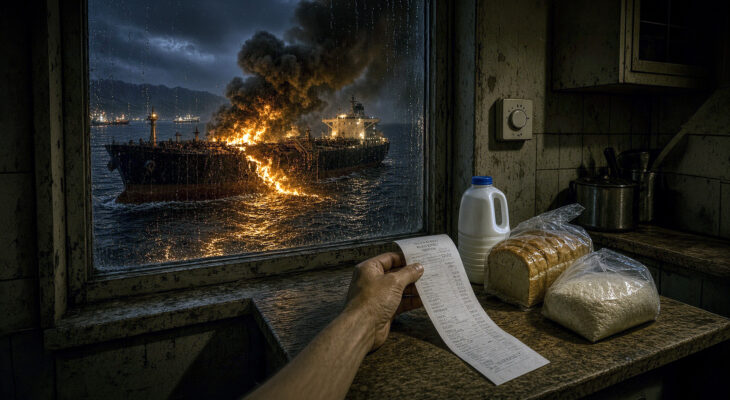
The tanker fire is a transmission belt: chokepoint → crude → diesel → the receipt in your hand.
The same shock tightens the rails that will settle your bill and your savings in code.
Orientation is free. Execution is not something you improvise after Friday’s CPI.
The Rekindled is the membership that turns this information into a working kit: “The Arsenal” across Economic, Strategic, Digital, and Mental Freedom:
Self-custody instructions, scenario tools, hardening you can finish, briefings aimed at your options, and the deeper cut of pieces like this one.
Awareness is cheap. Preparation is not…