
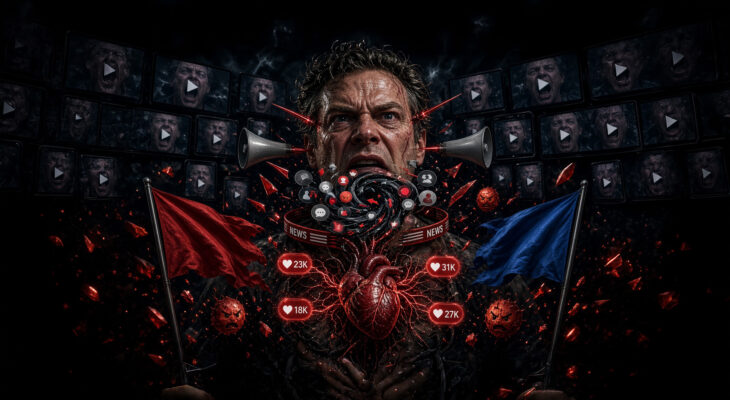
How Daily Outrage, Fear, and Moral Panic Are Used to Capture the Human Mind… and How to Interrupt Them.
As someone who spent a decade and a half working with Google I’ve had a great deal of opportunity to analyze how big tech and “The Powers That Be” operate through information systems and mass psychology, And as such, Emotional Hijacking is ALMOST INVARIABLY the first move in every successful campaign of influence.
Iran Bad! Israel Good!
Russia! Russia! Russia!
Evil Republicans!
Evil Democrats!
Stolen Elections!
Safe And Effective!
QAnon!
Does any of that sound familiar?
Propaganda supplies the story. Identity capture supplies the tribe. Emotional hijacking supplies the speed of your reaction.
Without the sudden spike of fear, outrage, disgust, or moral superiority, most people still have time to ask whether a claim is true. That time is what the modern information environment is designed to steal from you.
Jump To Section:
- What Emotional Hijacking Is
- How The Hijack Is Delivered
- Two Daily Arenas
- Why It Matters
- Recognizing the Attack
- Practical Resistance
- Thoughts On Mental Freedom
- There’s A Lot More To This…
IMPORTANT: While this article gives a comprehensive breakdown of how daily outrage, fear, and moral panic are used to capture the mind and how to interrupt them, deeper insight, further instruction, and more playbooks to fortify your mind and regain your Mental Freedom are available for our members. Find out more…
What Emotional Hijacking Actually Is
Emotional hijacking occurs when a strong feeling arrives first and thinking rationally is forced to catch up later… if it arrives at all.
The feeling is not a side effect of the message. It is the payload.
Once fear, rage, humiliation, or righteous anger is engaged, attention narrows, memory becomes selective, and complex analysis feels like evasion. The person is no longer examining a claim. They are defending an emotional state.
To be clear: Emotional Hijacking is distinct from ordinary emotion.
Emotion is information. Hijacking is the use of that information as a control system. The hijacked person treats the sheer intensity itself as proof: “If I feel this strongly, something real and urgent must be happening.”
In practice, however, that intensity is deliberately induced, through pacing, imagery, loaded words, repetition, and the social reward of reacting in public.
How the Hijack Is Delivered Every Day
The delivery system is continuous. A notification is a small emotional dart. A headline is a compressed moral verdict. A thirty-second clip is chosen for the moment that produces the strongest reaction, not the most accurate picture.
Three mechanisms do most of the work:
- Platforms and newsrooms compete for scarce attention, so content that produces a fast bodily response wins distribution.
- Political and commercial actors ignite a feeling and attach a conclusion to it.
- Public reaction becomes the next stimulus: likes, quote-posts, and pile-ons tell the nervous system that the emotion is shared, justified, and socially useful.
The result is a population that spends large parts of the day in low-grade emergency-mode, ready to accept emergency framing, treat delay as betrayal, and treat calm analysis as coldness or complicity.
Two Daily Arenas
The Crisis Feed
You open a news app or social feed and meet a headline built for an immediate verdict: catastrophe, betrayal, humiliation of “our side,” or danger from “the other side.” The first sentence names a villain and a victim. The featured image is chosen for impact. Context arrives much later in the article or video, if at all. By the time a correction or fuller timeline appears, the emotional imprint has already been made.
Most people never even see the fuller version or correction. They just get outraged and move on to the next doomscrolling headline.
The Tribal Outrage Loop
On platforms such as X, hijacking is often social rather than official. A clip is stripped of prior context. An out-of-context phrase is treated as a profession of character.
Worse still, users compete to display the strongest reaction because intensity signals loyalty.
The algorithm then supplies more of the same, because it’s designed to surface content that gets interactions and shares. Within minutes of getting algorithm-swamped a person can move from idle scrolling to moral certainty about someone they have never met and a situation they have not independently checked.
The feeling of being “awake” to an injustice can be very real. The reliability of the emotional trigger-mechanism is not.
In both arenas the “controller” does not need you angry forever. They only need you angry long enough to click, share, donate, vote, or accept a simplified story.
Why It Matters
Emotional hijacking is both a method of governance and a method of market capture. A public driven from spike to spike has little surplus attention for logical trade-offs, critical analysis, or consideration of first causes/second-order effects.
Questions about war, energy, money, public health, and institutional power become tests of “feeling.”
The person who cannot interrupt that emotional spike becomes a reliable transmitter/amplifier of whoever designed the hijacking attack. Their private life suffers as well: borrowed outrage enters relationships, late-night feeds break sleep-patterns, and ordinary situations/risks start to feel existential.
Mental Freedom is impossible while your nervous system is rented out to the bad guys by the hour.
Recognizing Hijack in Daily Life
Certain patterns reliably indicate that emotion has taken the controls:
- You feel an urgent need to react, share, or condemn before you can even state the claim in plain language.
- Your body reacts first: tight jaw, racing thoughts, heat in the face, a surge of righteousness or dread.
- The item arrives as a moral binary, with no room for incomplete information or competing logic.
- You rehearse a reply to an imagined opponent before you even check the source.
- Calm questions feel like betrayal. Delay feels like weakness.
- After the spike fades, you cannot clearly say what new fact you actually learned.
Practical Resistance: Interrupting the Spike
Resistance is not the suppression of feeling. Feeling is often the first signal that a message was built to move you. The goal is to keep the feeling from becoming “the judge.”
Insert a Deliberate Pause
When a headline, clip, or post produces a sudden surge, do not reply and do not share. Put your device down for two minutes. Name the feeling in one word: anger, fear, disgust, triumph. Naming it diminishes its claim to be identical with reality.
Most hijacks depend on the first ninety seconds.
Separate the Feeling from the Claim
State the underlying claim without adjectives. “This official said X.” “This video shows Y happening at Z time.” If you cannot state the claim without moral language, you do not yet have a claim. You have a mood.
Moods are not evidence.
Demand Time, Place, and Source
Ask when the event occurred, who recorded it, and what happened immediately before and after.
An out-of-context clip without a timeline is a hijacking tool.
A statistic without a denominator is a hijacking tool.
An “everyone knows” consensus without proof or documentation is a hijacking tool.
Delay Public Performance
Much of the hijack is completed only when the emotion is “performed” for an audience. Do not post while your body is still running emotionally hot. Write privately first and reread later.
Silence for an hour is not cowardice. It is taking custody of your own nervous system.
Reset the Body, Not Just the Opinion
Hijacking is physiological. A short walk, slower breathing, or standing up and looking away from the screen changes the state in which the next piece of information will be judged.
Change the state first.
Shrink the Emergency Diet
Turn off non-essential notifications. Batch news into one or two short windows. Follow fewer accounts that exist mainly to keep you inflamed. An information diet built of crisis fragments will keep producing crisis physiology, even when your actual life is not in crisis.
A Final Thought on Mental Freedom
Emotional hijacking thrives where speed of reaction is rewarded and delay is punished. Recovering the emotional pause is not a lifestyle accessory. It is the pre-condition for every other form of independent judgment you’re looking to exercise in daily life.
The goal is not to feel nothing. The goal is to keep “feeling” from becoming a substitute for “seeing.”
A person who can notice the spike, name it, and wait before acting remains capable of testing what is actually in front of them.
In an information environment designed to make that capacity rare, the emotional pause is a form of quiet resistance.
There’s A Lot More To This…
Recognizing the spike is only the first recovery of the mind.
Keeping that recovery under daily pressure when the next headline, clip, or tribe-signal arrives, requires practice, current intelligence, and methods that go beyond a single article.
If you want the fuller instruction on interrupting emotional hijacking, rebuilding independent judgment, and holding Mental Freedom as a durable capacity rather than a passing insight, join “The Rekindled.”
Membership opens the Mental Freedom section of The Arsenal: practical frameworks, current-threat briefings, and structured exercises designed for execution, not temporary awareness.