This is NOT the Future. This IS happening NOW.
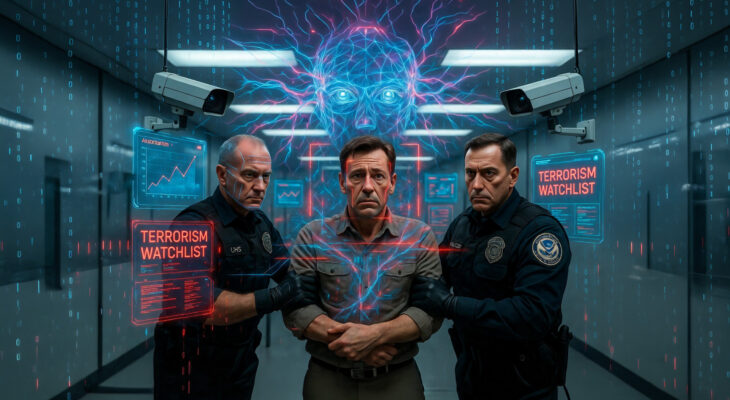
Federal prosecutors are trying to put a man in prison for the crime of protecting his private data. Samuel Tunick was flagged by AI-assisted surveillance systems for the sole offense of political association, detained at an Atlanta airport without a warrant, denied a lawyer, and ordered to unlock his phone.
When he triggered a duress PIN wipe instead, the Department of Justice charged him with destroying property to prevent seizure. This is not law enforcement. It is the state punishing a citizen for refusing to surrender his private, confidential information on demand, without a warrant.
Before we move on… The post written by one of our founders a couple of days back is a perfect example of just how much BTF has its finger on the pulse… Just Saying…
So What Happened?
Tunick was returning from a vacation in the Dominican Republic. Unbeknownst to him, an internal DHS email had already circulated his name and photograph under the heading of “suspected terrorism activities.” The sole basis for that designation was his alleged association with the movement opposing Cop City, the massive police training facility outside Atlanta.
No individualized evidence of violence or criminal conspiracy against him has been publicly produced. He was simply linked, by association, to a political campaign that authorities had already decided to treat as a domestic threat.
That linkage did not appear by accident.
Atlanta Police Department homeland-security units had spent years generating dozens of intelligence reports on Stop Cop City events, tracking not only protests but ordinary political activity, social gatherings, study groups, online likes and comments, and the like…
Those reports were shared with the FBI, DHS, and joint terrorism task forces.
Modern AI-driven surveillance systems convert such raw material into operational lists through automated tools: social-media scrapers that score language and networks, graph-analysis algorithms that map associations across several degrees of separation, and fusion platforms that elevate political alignment into risk scores.
Once those scores cross an internal threshold, a traveler’s name and face appear in the databases that Customs and Border Protection’s Tactical Terrorism Response Teams consult.
FunFact: This is nothing new. One of BTF’s founders was already being subjected to earlier versions of these pre-screening techniques almost a decade ago.
In short, Tunick walked into the secondary-inspection room already a marked man.
Inside that room the presumption of innocence evaporated. Agents questioned him about child sexual abuse material (nothing more than a weak pretext, according to his defense) as a front for probing his political connections. He requested a lawyer four times and was denied. No warrant was shown. No rights were read. He was told to unlock his phone or watch it be seized.
The encounter was not a targeted criminal investigation; it was the predictable endpoint of an AI-assisted profiling pipeline that treats political association itself as probable cause.
Faced with that demand, Tunick provided a passcode. The phone, running GrapheneOS, wiped its cryptographic keys. Its data became inaccessible. Prosecutors now call that act “destruction of evidence.” In reality it was the only remaining form of personal, digital self-defense available once the state had already decided he was guilty of association and therefore subject to a warrantless digital strip-search.
The right to privacy is not a privilege the government may suspend at the border for political convenience.
Article 12 of the Universal Declaration of Human Rights and Article 17 of the International Covenant on Civil and Political Rights of the United Nations protect individuals from arbitrary interference with their correspondence and personal data. Tunick’s device contained the ordinary private life of a citizen: messages, contacts, location history, political organizing notes. Compelling him to surrender that material under threat of seizure, then punishing him for rendering it unreadable, inverts America’s constitutional order. It declares that the state’s interest in data extraction outweighs the individual’s interest in confidentiality, and that “any technical measure which frustrates that data extraction is in itself criminal.”
Guilty Until Proven Innocent
This truly is the logic of “guilty until proven innocent” applied to the digital person. The state first constructs an arbitrary risk profile through AI mass association analysis. It then uses the attenuated Fourth Amendment rules of the border to force disclosure. When disclosure is successfully resisted, it invents a novel application of an old statute to punish the resistance. Ordinary people who value the privacy of their communications, their associations, or their political beliefs are thus placed on notice:
Effective technical self-defense WILL be treated as evidence of wrongdoing.
GrapheneOS remains one of the few operating systems (perhaps the only widely available one) that deliberately includes a duress PIN designed for exactly these high-coercion scenarios. The feature exists because its developers recognized that users may face demands they cannot safely refuse. By wiping keys rather than unlocking data, it preserves residual privacy when legal due process has already been abandoned.
That design choice is now under direct legal attack.
Another FunFact: BTF Members receive detailed operational guidance on implementing such protections and on traveling with devices that contain no sensitive material, capable of remote restoration after the border is cleared.
The Tunick case demonstrates why features like Duress PINs are no longer optional. When AI-driven profiling systems can convert political affinity into a watchlist entry, and when border agents treat the resulting secondary inspection as an opportunity for unconstrained data extraction, the only remaining safeguard is technologial self-defense.
The state has NOW MADE IT CLEAR that it will attempt to criminalize even that safeguard.
The response CANNOT be compliance.
YOU HAVE BEEN WARNED!


Holy shit so disturbing