
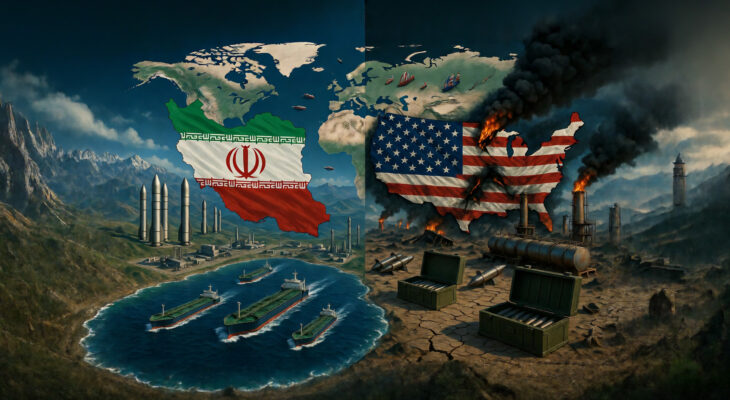
From my own long-term vantage point tracking power shifts across the globe, the current confrontation between the United States and Iran is not primarily a bilateral or even trilateral military contest. It is a revealing stress fracture in the late-stage American global hegemony, the ultimate demolition of which is Trump’s appointed task.
Make no mistake. What’s unfolding now is neither accident nor unforeseen consequence; it’s an essential component of the long-planned strategy to lead the world into a new system of political and economic control.
Jump To Section:
- The Old World Order
- The Military Reality
- Egocentric Decision-Making
- Energy As Strategic Terrain
- My Predictions
- Immediate Practical Steps For You
- A Symptom, Not The Disease
The Old World Order
The post-1945 system of American global dominance we’re currently living in rests on three pillars:
- Overwhelming conventional military superiority
- Reliable access to the world’s primary energy arteries
- The capacity of Washington to absorb the domestic political and financial costs of distant campaigns.
All three are now under extreme simultaneous pressure. The fighting that began at Israel’s behest with major U.S.-Israeli strikes in late February 2026 and re-intensified after the collapse of the June Islamabad memorandum is simply the most visible theater in which these structural pressures are being exposed.
What the media portrays as “just another” Middle East crisis is, at its core, a demonstration of the hard limits of sustained American/Israeli military power projection in an emerging multipolar world. As the costs of maintaining those three pillars rise through munitions depletion, disrupted energy flows, and growing domestic political resistance, the global economy is dragged, kicking and screaming, into the new paradigm.
One of the clearest economic signals of the emerging new world order is the accelerated global shift toward trustless, tokenized systems: blockchain-based settlement, tokenized real-world assets, and decentralized financial rails that reduce reliance on the traditional dollar-and-energy order. In short, the pressure on the old system’s pillars is hastening the move into a more multipolar, less trust-dependent monetary and trade architecture.
And that’s not by accident.
This emerging architecture intersects directly with long-standing World Economic Forum priorities. The WEF has consistently advocated for the digitization and tokenization of assets, programmable money, interoperable digital identity systems, and public-private coordination of global supply chains and finance.
So what appears as a multipolar fragmentation of the old dollar-centric order will, in practice, accelerate the very infrastructure the Forum has promoted: a more trackable, programmable, and institutionally coordinated economic system in which traditional trust is replaced by code, verification layers, networked governance frameworks, and far deeper control over the world’s population.
“Yu vill own nozhing und yu vill be happy.”
~ Klaus Schwab
But anyways…
The Military Reality
American forces continue to strike Iranian targets while absorbing repeated highly-effective missile and drone attacks on bases across Jordan, Kuwait, Bahrain and beyond. But more consequential than any single exchange or strike is the relentless math of consumption caused by prolonged conflict. Critical munitions, like Patriot and THAAD interceptors, Tomahawk cruise missiles, and related precision systems, have been expended at rates the military-industrial base cannot replenish in anything resembling operationally relevant timelines.
Independent assessments and reporting based on U.S. officials indicate that inventories of several key categories were already reduced by roughly half during the opening intensive phase, with frankly unsustainable numbers being expended daily as the conflict drags on. Production lead times for their replacements are now measured in years rather than months.
Speaking to the Washington Post one senior official stated flatly that “the United States does not have enough to sustain operations safely at the current tempo.”
This is not a temporary shortage.
It is the predictable result of a military instrument designed for short, decisive campaigns against weaker adversaries now having to deal with a war of attrition against Iran, while simultaneously being used to support Ukraine and maintaining deterrence capabilities against China in the Western Pacific.
To be sure, the United States still possesses formidable military stocks and capabilities, but its effectiveness in concurrent high-intensity commitments has been weakened dramatically.
Iran, by contrast, continues to launch attacks, effectively laughing in the face of “Pistol Pete” Hegseth’s claims that the Iranian military and its capabilities have been destroyed once and for all. What’s more, unlike America Iran still retains a substantial portion of its pre-war missile inventory. It’s an immutable military reality in any attrition-campaign that success vastly favors the side that can sustain pressure longer, even when that side has less sophisticated but still effective systems.
In strategic terms, the United States is discovering that technological superiority does not automatically translate into sustainable operational superiority when the industrial base cannot keep pace with consumption.
Egocentric Decision-Making and Alliance Distortion
Trump’s approach has been consistent with a broader American pattern of treating foreign policy as an extension of personal posturing and political theater. Endless threats of escalating strikes on infrastructure, public rejection of short mediation pauses, and framing the campaign in binary terms of national strength versus abject humiliation leave no room for the quiet conservation of increasingly limited resources.
In short, Trump’s ego-driven, hyperbolic approach is further accelerating the depletion of munitions, not to mention political capital at home.
To put that in context, public approval for the Iran war is now lower than it was for Vietnam at the end of that conflict.
Layered on top of Trump’s ego is the long-standing toxic influence of Israel on American policy toward Iran. Successive Israeli governments have treated the Iranian nuclear programs and its regional standing as existential threats, and have pressed Washington toward maximum pressure and, when possible, kinetic action. That influence is not new, nor is it absolute. Recent public comments by Vice President Vance on the Joe Rogan Show, acknowledging Israeli efforts to shape American opinion against negotiated outcomes amply surface Israel’s unhealthy leverage over Congress. And while he took an extraordinary amount of fire for his comments, he merely made public a structural reality that has existed on Capitol Hill for decades.
The simple fact is that American policy has long prioritized the petulant demands of its “Supposedly Greatest Ally” over a strictly American assessment of costs, timelines, and lost opportunities elsewhere in a world of finite resources.
Energy as Strategic Terrain
The military contest is also being fought on the energy map.
Tanker traffic in the Strait of Hormuz remains severely constrained. The Houthis’ maritime embargo on Saudi-linked shipping has placed additional pressure on the Red Sea alternative route through Yanbu. Consequently Brent crude has moved above $98–$100 per barrel in recent days.
It’s worth mentioning at this stage that the U.S. Strategic Petroleum Reserve has fallen to approximately 311 million barrels (roughly 43% to 44% capacity, the lowest level in over four decades) after significant depletion since the war began.
Energy is no longer a background factor, the way it was in the “Old System.”
It is now the primary transmission mechanism through which distant conflict impacts our households and industries on both sides of the Atlantic. Higher crude oil prices feed directly into gasoline, diesel, heating fuels, fertilizers, chemicals, and transportation costs. Europe, already managing self-inflicted tight natural-gas balances and growing industrial competitiveness challenges, faces particularly acute exposure as winter approaches.
The United States is better positioned in production terms but is far from insulated against price spikes or the political consequences of sustained elevation/hyperinflation in living costs. When governments keep drawing down their emergency oil reserves and commercial stockpiles stay unusually low, the safety margin that used to cushion sudden price spikes gets thinner, and the population is quick to notice this.
The result is faster and more visible intrusion of geopolitical volatility into everyday economic life.
This is the larger reality: Physical Iranian/Houthi control of energy chokepoints and America’s diminishing ability to sustain military operations are converging to make life increasingly difficult for Western nations.
The side that can impose costs on the global energy system while preserving its own resilience gains leverage that pure battlefield metrics do not capture.
My Predictions
- Material limits will force an adjustment in American operational tempo within weeks to a couple of months. Continued expenditure at the present rate is not sustainable given the state of key munitions stocks. The adjustment may take the form of a de facto pause, a shift to more limited strikes, or a negotiated temporary arrangement framed as strength rather than concession.
- Oil prices will remain structurally elevated and are likely to test significantly higher levels if Red Sea disruption deepens or additional infrastructure is struck. A sustained move toward or beyond $110–$120 becomes a realistic scenario under continued dual-route pressure. This will accelerate Strategic Petroleum Reserve draws and intensify political pressure in Washington and European capitals for some form of de-escalation.
- Domestic economic and political backlash in the United States and Europe will become a far more decisive cause for constraint through late summer and autumn than pure military developments on the ground.
Rising energy and food costs effectively function as a broad-based and “highly unpopular” tax. Political systems that must answer to voters every few years are more sensitive to local public outrage pressure than they are to distant measures of military prestige or incremental territorial gains.
Immediate Practical Steps
The rest of this year will be a political and economic rollercoaster, but there are concrete steps you can take to improve personal resilience without requiring perfect foresight:
- Keep vehicle fuel tanks topped off and, where legal and safe, maintain a modest approved reserve. Avoid operating any car or machinery near empty.
- Review and, if practical, increase home heating fuel stocks (oil, propane, or solid fuel) before seasonal demand rises or economic developments force price-rises.
- Reduce discretionary energy and transport use now. Efficiency remains the cheapest and most reliable buffer available to most people.
- Strengthen short-term cash or liquid reserves. Energy-price shocks act like a sudden tax; personal liquidity preserves your options when costs rise.
- Identify local or regional sources of food and fuel that are less dependent on long international logistics chains.
- Track weekly Strategic Petroleum Reserve and commercial inventory data alongside Brent and WTI prices. These remain the clearest early indicators of tightening conditions.
- For those with capacity, consider modest, risk-aware exposure to energy or broader commodity positions as a partial offset, while recognizing the inherent volatility of such investment instruments.
- Reinforce basic household resilience aside from energy, like water storage, non-perishable food reserves, stockpiling essential medicines, so that sudden price stress or supply problems do not compound other vulnerabilities.
The Iran Conflict is a Symptom, Not the Disease
It is exposing the limits of sustained American power projection, the fragility of energy supply routes, and the growing inability of the old alliance-and-dollar system to reconcile stated commitments with material reality.
What is emerging in its place is not simply a multipolar order of competing nation-states, but a more tightly engineered system of global economic and political control built on tokenized assets, programmable settlement, and reduced reliance on traditional trust. It’s time to realize that the current upheaval is custom-designed to accelerate that transition.
Clarity about these dynamics is itself a form of preparation. The costs will arrive at the pump, the heating bill, and the grocery receipt long before any formal declaration that the strategic and economic landscapes have changed.