
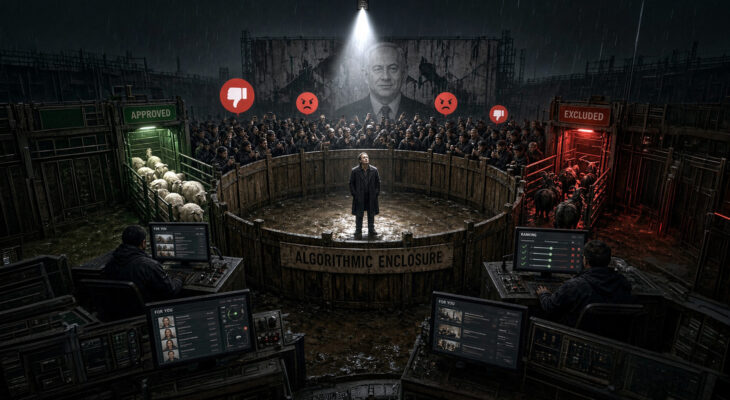
Filter Bubbles and Algorithmic Enclosures: Peer Pressure Without a Raised Voice.
In my last guide I showed you how to stand against social conformity and peer pressure. This article leads directly on from that.
It is a fact well known to those who know it well that I know a thing or two about information systems and how “The Powers That Be” (TPTB) use them to influence the masses. And if a decade and a half working with Google has taught me anything, it’s that algorithmic filtering is the silent partner of social conformity.
Social conformity is about what happens in the visible room: The meeting, the pile-on, the neighbor who asks “who is doing their part,” the vocal suppression of dissent.
Algorithmic filtering is about how the crowd in that room is assembled before you ever enter it.
No one has to shout. The feed decides who is in earshot, which facts are put front-and-center, and which faces never appear.
Social Conformity still collects the tax. The algorithm simply makes the payment feel like “good taste.”
Jump To Section:
- What The Enclosure Is
- How It Partners With The Mob
- How It’s Delivered Daily
- Two Daily Arenas
- Why It Matters
- Recognizing The Enclosure
- How to Leave The Enclosure
- The Standard You’re Shooting For
What the Enclosure Actually Is
An algorithmic filter bubble is not “people you agree with.” Agreement is ordinary.
The filter bubble is a ranking system that hides the cost of being wrong by making sure you never see “evidence that counters the narrative.” It repeatedly shows you the approved version of the world that keeps you scrolling, and it starves you of the version that would force a revision of your views.
Over time the missing evidence stops feeling like it’s “missing.”
It feels like it never existed.
An algorithmic enclosure is stricter. You can theoretically leave. In practice the exits look empty, hostile, or fake, because the system has trained your sense of what’s acceptable for “normal people” to believe.
A crowd you never meet becomes the jury judging the acceptability of your thoughts and behavior.
That is why this mechanism is the partner in crime of peer pressure. Conformity needs a majority that will not be seen dissenting. The feed manufactures the appearance of that majority and then rents it back to you as a “For You” page.
The operator does not need to censor a sentence if it can simply bury the person who would have said it. Silence by ranking is cheaper than silence by ban, and it leaves the user with the pleasant conviction that “they chose the right room.”
How It Partners With the Mob
Social conformity works by example. One person is publicly chastised; the rest update their behavior.
The algorithm industrializes that example. It boosts the performance of disgust inside your cluster and hides the unpunished dissenter outside it. You do not see the colleague who asked the clarifying question and kept their job. You see the clip of the one who was destroyed.
“Availability” does the rest. The mind treats what is easy to recall as what is most common.
The COVID years made the partnership obvious. Two households on the same street lived inside different evidence diets: different experts, different banned phrases, different “settled” claims, different villains. Official language moved while the feeds treated each local script as the only adult position.
As a direct result, people did not merely disagree. They lost the shared table on which that disagreement could happen.
When later reviews and reversed guidance arrived, most of the indoctrinated met them as foreign objects, content from a country they did not live in.
The same machine now runs on war, money, identity, and climate. The slogans change. The algorithmic enclosure does not.
How It Is Delivered Every Day
Three levers do most of the work:
- Ranking: What rises is what keeps you inside the cluster, not what would correct it.
- Social graph: Recommended follows, “people you may know,” and mute-and-block cascades sort you into a room that already agrees with you.
- Unfinished loops: Each session ends on a half-resolved outrage, so you return to the same enclosure to finish closing it. The body cooperates. Unfamiliar sources feel unsafe. Familiar outrage feels like news.
None of this requires a conspiracy in a basement, thought TPTB are certainly making full, coordinated use of the mechanisms.
Engagement is the incentive. A feed that showed you the strongest case against your own views would lose not only the session, but would jar your mind into “Wrongthink.” A feed that shows you the weakest case against your side keeps you “righteous and present.”
Righteous and present is the end-state your algorithmicly groomed information-diet produces.
Two Daily Arenas
1. The Political For You Page.
You open a platform to “see what’s happening.” What arrives is a sequenced jury: The approved framing first, the mocking of the other side second, the pile-on third, as proof that “decent people have already decided.”
You can spend an hour “being informed” and still be unable to state the other side’s best argument. That is not a news failure. That is enclosure working.
2. The Professional Recommendation Engine.
LinkedIn, YouTube, newsletter apps, even internal Slack search. The system notices which takes get reactions in your circle and feeds you more of the same tone.
By the end of the quarter, your industry’s “common sense” is just the cluster’s last winning performance. People who work in the same building no longer share anything resembling a “fact pattern.” They share an algorithmic ranking history.
Why It Matters
A public that cannot see the opposing case cannot test the merit of its own. Error becomes identity. Identity becomes a loyalty test.
The test is then enforced twice: Once by the visible room, once by the invisible one that never even invites the heretic in to begin with.
This also completes the other captures. Propaganda is safer if the rebuttal never ranks. Identity capture tightens if leaving the tribe means leaving the only feed that still recognizes you. Emotional hijacking lasts longer if calm counter-evidence is treated as off-topic. Stolen attention stays stolen if every session returns you to the same enclosure. And social conformity becomes easy because the crowd appears unanimous… and that unanimity was assembled “just for you.”
Now doesn’t that make you feel special?
How to Recognize the Enclosure
Watch for these signs in ordinary hours, not while you’re being outraged.
- You cannot state the other side’s stance in three sentences.
- Your “research” is a stack of people who already share your conclusion.
- You are shocked, daily, that millions of adults believe something you’ve never seen argued coherently.
- Your next set of recommended follows look like cousins of the last twenty.
- You use “everyone knows” about a claim youve only encountered inside one platform.
- Reading a primary document (an actual study, statute, filing, or transcript) feels like a chore next to watching the latest viral clip.
If several of those are true, you do not have a preference. You have a sorted room where your feed is writing the guest list.
How to Leave the Enclosure Without Joining the Opposite Cult
The aim here is not to flip tribes. The aim is to stop mistaking a groomed ranking system for a public consensus.
1. Name the enclosure before you open it. Say the job of the session out loud: “I am entering a ranked room built from my last reactions.” That one sentence breaks the spell that this is just the ordinary world arriving. If you cannot name the purpose for opening a door, do not unlock it.
2. Force one steel-man per live dispute. For any fight that is currently eating your feed, write the strongest case against your side in language its serious advocates would accept. If you cannot, you are not informed. You are enclosed. Do this before you post anything.
3. Keep one serious opponent in the graph. Not a clown. Not a rage account. One person who argues the other case with documents. Mute the mob around them if you must. Do not mute the argument. Conformity dies when even a single competent dissenter remains visible.
4. Prefer primary paper to secondary performance. When a claim moves money, war, medicine, or law, go to the filing, the paper, the statute, the transcript. The enclosure lives on third-hand recaps. Primary text is boring on purpose. That boredom is a defense protecting TPTB’s agenda.
5. Break the single-feed habit. Do not let one ranking system be your window. Use chronological lists where they exist. Rotate sources that do not share the same owner, advertiser, or congregation of cuiltists. An information diet with one kitchen is neither healthy nor balanced. It’s monotrophic, like eating nothing but Big Macs each and every day.
6. Schedule contact with the unranked world. Once a week, get a fact from a place no algorithm invited you: a hearing, a local meeting, a paper you searched for by name, a conversation with someone who does not know your online persona. The enclosure cannot assemble a crowd that is not on its platform.
The Standard You’re Shooting For
You will not live without filters. The mind filters. Institutions filter. The question is whether you can still see the filter working. Social conformity needs a room. The feed now builds the room, stocks the jury, and calls the end result “your best interests.”
Stand far enough outside the ranked current to feel the drag. That drag is the opposing case. If you cannot find a competent opponent on your own feed, the crowd the algorithm assembled has already voted… and you were counted with them.
IMPORTANT: While this article gives a comprehensive breakdown of how filter bubbles and algorithmic enclosures partner with social conformity to capture judgment, deeper insight, further instruction, and more playbooks to fortify your mind and regain your mental freedom are available for our members. Find out more…