
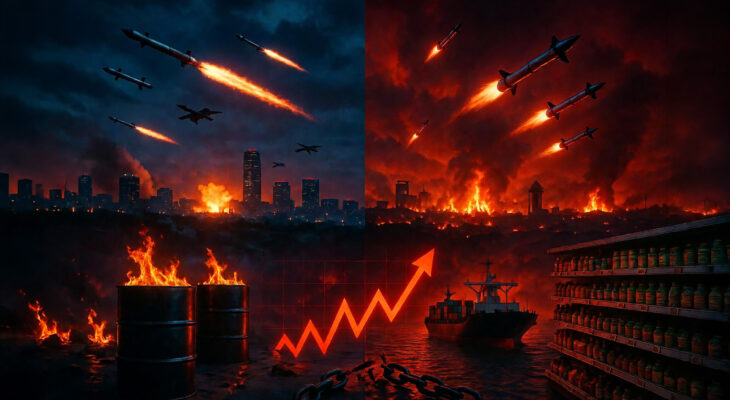
The Middle Eastern events of the past 48 hours represent an extremely dangerous escalation that is being VERY deliberately understated in much of the mainstream coverage. On June 7-8, Iran launched ballistic and cruise missiles in response to Israeli strikes on Beirut suburbs, prompting Israel to retaliate with standoff cruise missiles and air-launched attacks targeting Iranian airports, missile production facilities, drone sites, and air defenses near Tehran, Isfahan, and elsewhere.
Both sides have now signaled a pause, but the underlying dynamics point to a volatile escalation cycle rather than a long-term resolution.
This is no longer abstract geopolitical wrangling. Israel’s increasingly aggressive and imperialistic stance now directly threatens energy prices, supply chains, inflation, and food security for the entire world’s population.
Jump To Section:
- Netanyahu’s Personal Survival Imperative
- The Burden on the USA
- European Fecklessness
- Global Ripples
- Practical Implications
Netanyahu’s Personal Survival Imperative Overrides All Else
At the core of this unending conflict-escalation stands Israeli Prime Minister Benjamin Netanyahu’s drive for political and personal survival.
Facing both domestic political challenges and long-standing legal pressure for alleged bribery/fraud1, Netanyahu has doubled down on an aggressive doctrine of “permanent security,” which is to say “eliminating anything he labels as a threat” not just in Gaza but across Lebanon (pushing toward the Litani River) and now directly confronting Iran. Analysts across the spectrum, including former CIA professionals and seasoned diplomats, note that Netanyahu views continued military action as essential to maintaining his coalition, avoiding political collapse and potentially a lengthy jail-term.
His public defiance of U.S. calls for de-escalation, including reported rejection of calls from President Trump urging restraint, as well as public statements like emphasizing his ability to say “No” to Washington underscore the overarching nature of this survival imperative. Netanyahu’s stance is beyond unreasonable in its overreach: it risks turning limited proxy conflicts into a wider regional war, ignoring the exhaustion of Israeli forces and the hardening resolve of the “resistance axis” (Iran, Hezbollah, Yemen, and other allies.)
Iran’s newly articulated regional security doctrine: “Ceasefire for all or ceasefire for none,” encompassing Lebanon and Palestinian areas, now means further Israeli actions in Beirut or Gaza will trigger broader, harder retaliation, including further potential Hormuz disruptions.
In short, Netanyahu’s “mowing the lawn2” approach in Gaza and Lebanon is no longer locally containable; it is progressivle exporting violent instability both regionally and globally.
The Burden on the United States
Unconditional U.S. support for this approach is becoming an increasingly heavy and counterproductive burden. President Trump has attempted to restrain Netanyahu to safeguard ongoing Pakistan-mediated talks with Iran and avoid political quagmires, reportedly telling him “I call the shots.“
And yet, Israeli spying on Trump administration officials (including key negotiators like Elbridge Colby and Steve Witkoff) and Netanyahu’s open defiance highlight the frankly laughable limits of U.S. leverage over the Israeli regime, placing the one-sided nature of the U.S./Israel relationship in stark contrast to the public/media “greatest ally” narrative.
This dynamic carries multiple costs for America.
Militarily, it risks drawing U.S. forces into another open-ended conflict on behalf of Israel, at a time when resources are already stretched by other priorities.
Economically, it exposes the U.S. to volatile energy markets and higher defense spending that could otherwise support domestic infrastructure or debt reduction.
Politically, it is severely damaging Republican prospects. Recent polling shows alignment with Netanyahu’s actions is hurting the party, with younger voters and independents becoming increasingly alienated.
Consequently, Trump’s own rhetoric has shifted from the stated intention of “annihilation” toward increased restraint, signaling a recognition that endless entanglement and/or support of Israel/Netanyahu does not serve America’s long-term interests.
If that is indeed the case, the United States stands to benefit substantially from ending unconditional support of its “greatest ally”:
- Strategic freedom: Greater leverage in negotiations with Iran, Gulf states, and emerging multipolar powers for stable energy flows and trade deals.
- Fiscal relief: Reduced military commitments abroad free up trillions over time for domestic priorities like border security, infrastructure, and economic competitiveness. And that’s not even taking into account the $3.8 Billion of “aid” given to Israel each year by America.
- Restored credibility: A recalibrated foreign policy, focused on American interests over those of Israel, regains public trust and reduces the national/international perception of the U.S. as an enabler of regional chaos.
- Election-year advantage: Distancing from Netanyahu’s unpopular actions would objectively blunt Democratic attacks and consolidate support among the countless voters who are tired of foreign wars.
Inversely, continuing the current path risks dragging the U.S. into another Middle East morass at precisely the wrong economic moment, drastically undermining Trump’s overt America First agenda.
European “Fecklessness” and Acute Vulnerabilities
Meanwhile, Europe’s incoherent response (or lack thereof) exemplifies what analysts frequently call “European Fecklessness…“ a pattern of tough rhetoric, sanctions, and NATO posturing without the strategic autonomy, military capacity, or unity to back up Von Der Leyen’s big words.
Make no mistake, the EU remains heavily dependent on imported energy, lacking self-sufficiency despite years of endless talk about energy-diversification and sustainability. Another serious disruption in the Strait of Hormuz, through which a significant portion of global oil and LNG flows, would hit Europe far, far harder than the United States.
Europe’s Chief Vulnerabilities Include:
- Energy exposure: Reliance on volatile imports leaves the continent facing immediate price spikes and shortages. A prolonged Iran conflict will almost certainly result in energy rationing.
- Incoherent decision-making: Fragmented among its member states, Europe struggles to formulate a coherent, unified response beyond figurehead statements and soundbytes. In fact, as the situation in the Middle East deteriorates, so are calls for the EU’s abolition growing in several European countries.
- Defense shortfalls: There’s an almost ridiculous inability for the EU to project power independently without U.S. support. Meanwhile Europe’s impotent posturing towards Russia alone is enough to potentially “call down a military thunder” the continent is objectively unable to survive on its own.
This fecklessness amplifies risks: Any sustained Israel-Iran exchange threatens European inflation, industrial slowdowns, and potential refugee flows.
Meanwhile, Russia and China are observing this weakness with strategic satisfaction, and using it to accelerate their own multipolar agendas.
Global Ripples: Oil, Resources, and Food Security
The conflict’s economic fallout is already materializing and will only intensify with time.
Oil prices are on track to breach $100 per barrel as a near-certainty in the coming weeks, driven by Hormuz tensions, tanker insurance spikes, Iranian transit fees, and mounting fears of broader escalation by Israel/Netanyahu.
Here’s What’s Coming:
Near-term (weeks to months:) Sustained $100+ oil with sharp volatility. Even limited disruptions (e.g. a 500,000 barrel per day shortage affecting Chinese refining) will raise global energy benchmarks significantly. In Europe, this translates to gasoline and heating costs jumping 15-25% (conservative) in short order, compounding existing energy inflation, and hammering household budgets as well as energy-intensive industries like chemicals and manufacturing.
The U.S. will feel it through higher pump prices (potentially $4.75-$5.75/gallon nationally) and increased costs for trucking and aviation, rapidly feeding into broader CPI rises.
Mid-term (months to 1-2 years): Prolonged tit-for-tat cycles or Lebanon flare-ups entrench higher baseline energy costs. Hyperinflationary pressures build in import-dependent economies through compounding supply chain stresses.
Europe faces acute risks: natural gas and electricity prices could easily surge 30-50%+, triggering renewed industrial shutdowns (as seen in 2022) and food price spikes in staples like bread, dairy, and imported produce. Food production stresses emerge as fertilizer and diesel costs rise, reducing yields on European farms already strained by weather and regulations.
In the United States, while domestic shale offers some buffer, downstream effects will hit consumers via grocery bills (10-20% increases in meat, grains, and packaged goods) and corporate earnings, widening the K-shaped economic divide. Import-dependent regions and low-income households suffer most, with potential localized shortages in fresh produce and processed foods.
Long-term (2+ years:) Accelerated multipolar fragmentation. Russia and China gain from alternative energy routes and higher prices; the K-shaped economy widens as affluent actors hedge via tokenization, real-world assets (RWAs,) and stablecoins, while others face chronic stresses.
Food production faces systemic risks from sustained high energy inputs, reduced yields in stressed regions (Middle East, North Africa, parts of Europe,) and geopolitical trade barriers. Global fertilizer shortages could cut crop outputs by 10-15% (again, conservative) in vulnerable areas, raising famine risks in poorer nations and driving migration pressures back toward Europe and U.S. borders.
These are not hypothetical scenarios but logical extensions of current trajectories.
What’s more, Yemen’s Iran-backed Houthis represent a major wild card in the whole Israel-Iran conflict. They have already launched missiles toward Israel in coordination with the recent escalation and have threatened to resume attacks on Red Sea shipping if the situation worsens.
Because they operate with a large degree of independence and are backed by competent support and tech, their decision to intensify strikes on Israel/U.S. assets, or key maritime chokepoints could rapidly expand the war, disrupt global oil and trade routes further, and stretch Israeli/U.S. defenses even thinner.
This makes the Houthis an unpredictable and potentially game-changing player.
Practical Implications and Paths Forward
For those of you seeking to protect your families and capital without exhaustive daily research, the message is clear: Sovereignty and resilience are no longer optional.
Netanyahu’s survival-driven aggression is accelerating a world of higher volatility, energy insecurity, and fractured alliances.
The U.S. decoupling from unconditional support of Israel could mitigate risks stateside, but Europe’s vulnerabilities and global fragmentation will face prolonged turbulence, regardless.
This aligns with broader shifts toward multipolarity and the accelerating need for personal empowerment.
Diversify energy exposure, which is to say:
Don’t have too much money tied up in companies or assets that get hurt badly when oil prices spike (e.g. airlines, trucking firms, petrochemicals, or pure fossil-fuel heavy portfolios.)
Instead, spread your money across:
- Renewable or alternative energy sources
- Energy-efficient companies
- Commodities like gold, silver, or tokenized real-world assets (RWAs)
- Stablecoins or other hedges that perform better during energy volatility
Seriously consider hard assets and decentralized financial tools, and prioritize personal privacy and local resilience:
Personal Privacy:
Reducing how much of your data, finances, communications, and movements are tracked by governments, Big Tech, or corporations.
- Practical steps: Using encrypted tools (like Signal or other privacy-focused apps, secure email (ProtonMail, RunBox, etc) minimizing social media oversharing, protecting financial data, and hardening your devices against surveillance.
- Why now? Escalating conflicts and multipolar tensions often lead to more government control, digital tracking, and censorship. Protecting your privacy now preserves your freedom and security going forward.
Local Resilience:
Building self-sufficiency closer to home so you’re less vulnerable to distant crises (like Hormuz disruptions driving up oil/food prices.)
- Examples:
- Stocking reasonable supplies of food, water, medicine, and fuel
- Supporting local farms, markets, and businesses
- Investing in home energy solutions (solar, wind, efficient heating)
- Building strong community networks and skills (neighbors, local barter/trade)
- Diversifying income and assets away from the fragile global “system-of-systems”
Here at BackToFreedom we will continue synthesizing these developments into actionable “Keys to Freedom.” Because navigating this global fire requires planning and preparation, not panic.
Stay informed, stay sovereign. Developments in Lebanon and Hormuz, in Yemen, and with BRICS will dictate the next phase of geopolitical evolution.
And we will track them closely.
1 Israeli Prime Minister Benjamin Netanyahu faces ongoing corruption trials (indicted in 2019) on charges of bribery, fraud, and breach of trust in three main cases. These involve allegations that he accepted lavish gifts from wealthy donors in exchange for regulatory favors, sought a media deal for positive coverage, and granted regulatory benefits to a media mogul in return for favorable news coverage.
He denies all wrongdoing; the trial has been protracted with frequent delays, including recent postponements citing security concerns amid regional conflicts. Netanyahu has also sought a presidential pardon.
2 “Mowing the lawn” (or “mowing the grass”) is an Israeli military term for periodic, limited operations aimed at degrading the capabilities of groups like Hamas and Hezbollah through repeated strikes, without seeking a permanent resolution. Netanyahu and other officials use it to describe routine “maintenance” of threats in Gaza and Lebanon. Critics view it as a dehumanizing euphemism for cyclical violence.