
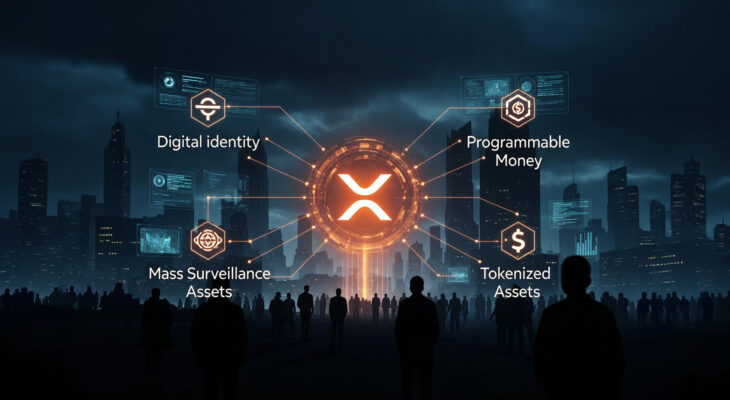
REALLY Deep Dive… Not for the fainthearted.
XRP is commonly presented and perceived as a utility token purpose-built to improve cross-border payments for banks. But what if there’s more to this cryptoken and its history than the official narrative discloses?
There’s actually plenty of evidence to suggest that XRP and XRP-Ledger (XRPL) were developed as part of a long-term strategy to facilitate a controlled transition away from the existing debt-based monetary system, if one bothers to do a little digging and analysis.
So… Where to start?
Jump To Section:
- Just The Facts Ma’am
- Tinfoil Analysis
- “The Reset” Phase 1
- “The Reset” Phase 2
- “The Reset” Phase 3
- Core Mechanisms
- The Endgame
The Facts Ma’am, Just The Facts
Yes, let’s start with the ice-cold facts, because without those I’m not actually an analyst, but just another wild-eyed conspiracy nut shouting meaningless ravings into the void.
To understand the current state of play, as well as public perception of the token, it helps to place XRP and the XRP Ledger in historical context alongside Bitcoin, the first major cryptocurrency.
Bitcoin Enters The Ring
Bitcoin was introduced in a whitepaper published on October 31, 2008, by an anonymous creator using the name Satoshi Nakamoto. Its network officially launched on January 3, 2009, when the first block (known as the genesis block) was created.
The first Bitcoin transaction occurred nine days later, on January 12, 2009.
Ostensibly designed as a decentralized, peer-to-peer electronic cash system in which new coins are gradually released through a competitive mining process, with no central company controlling the actual token supply itself Bitcoin was hailed as the “future of decentralized finance,” that “enabled users to become their own bank.”
The Emergence of XRP
Officially, XRP and the XRP Ledger emerged several years later with an entirely different technical approach and purpose. The XRPL was developed by a small team of programmers (David Schwartz, Jed McCaleb, and Arthur Britto) and officially launched on June 2, 2012. On that day, all 100 billion XRP were created at once in the ledger’s first block; no mining process was used. A few months later, in September 2012, NewCoin, the company that would become Ripple was founded to build practical applications for the technology. From the beginning, the XRPL was engineered for speed and low-cost movement of value between different currencies, commodities, and institutions, rather than as a purely decentralized store of value like BitCoin.
XRP Has Come A Long Way Since Then
As of now, XRP and the XRP Ledger have gained meaningful utility and adoption on the international stage primarily through cross-border payments and the growing amount of tokenization of real-world assets. Ripple’s On-Demand Liquidity (ODL) solution has been deployed by financial institutions like JP Morgan and Santander, and payment providers like Mastercard across multiple corridors to enable faster and more cost-efficient international transfers by using XRP as a bridge asset.
More recently, the XRP Ledger has seen increased institutional adoption in the tokenization space, with platforms such as Ondo Finance (another rabbit hole1) issuing tokenized U.S. Treasury products directly on the ledger and integrating them with stablecoins like Ripple’s RLUSD. High-profile collaborations involving institutions such as Standard Chartered Bank and the Mitsubishi Financial Group have further demonstrated the ledger’s capability for rapid, cross-border settlement of tokenized assets.
Those are the “official” facts behind XRP, its genesis, and its current uses in the financial world around us.
Pretty straightforward, right?
Now If I Was “Conspiracy-Minded,” Here’s What I Might Say:
XRP Is A Foundational Block Of The Long-Planned Economic Reset
A coordinated, multi-decade effort has been underway since before the 2008 financial crisis to replace the existing debt-based fiat system with a new, global, tokenized, asset-backed monetary architecture.
Its goal is not chaos or collapse, but a controlled transition that preserves the balance of power among a relatively small and narrow group of technocratic, financial, and institutional players.
Let’s take a closer look at that, starting with Ripple itself.
What If I Told You That The Concept of Ripple Predates Bitcoin By Years?
In 2004, a Canadian named Ryan Fugger, whom I’ll get to in a moment, released RipplePay.com as a seemingly idealistic experiment in decentralized, peer-to-peer credit. On the surface it looked like an early attempt at creating money without banks… in much the same way as its online contemporary: the Community Exchange System (CES)
In reality, RipplePay was the first public blueprint for what would later become the tokenized financial control grid. It introduced the core concepts (like a shared ledger, trust lines, and a neutral bridge mechanism for value transfer) that would eventually evolve into the XRP Ledger. By contrast the CES project contained none of these sophisticated elements.
RipplePay was purchased by OpenCoin (later to become Ripple Labs) in 2013, with OpenCoin citing the “Ripple” brand name as its primary reason for the acquisition.
But in reality OpenCoin wasn’t buying an old project simply for its brand name. It was absorbing the original architectural ledger-seed, planted nearly a decade earlier by someone with deep historical ties to elite finance.
Wait! What?!
That gave you pause, didn’t it?
Ryan Fugger isn’t just some rando who idealistically happened to invent RipplePay in 2004. There are VERY PERSISTENT claims that he is a direct descendant of the German Fugger banking dynasty, one of the most powerful financial bloodlines in European history, who supplanted the Medici as Papal financiers and predated the economic rise of the Rothschilds (though not the Rothschild family itself) by centuries. Indeed, the Fugger family still holds great wealth and aristocratic prominence in Germany to this day.
The Fuggers financed emperors, controlled silver and copper mines across Europe, and helped shape the early modern financial system through debt, trade monopolies, and political influence. The name Fugger itself is Middle High German in origin, meaning “Monopolist” or “Usurer,” so there’s an above average chance it’s actually a pseudonym used to cover another, far older, family name.
OK, so the actual family historical record is a little foggy about Ryan’s relation to the Fugger clan, but… How much do you believe in coincidences?
In any case, the simple fact is that the core concepts of shared ledgers, trust lines, and neutral bridge mechanisms were created by Ryan Fugger and later acquired by the company that was to become “Ripple Labs.”
Make of all this what you will…
Back To XRP’s Role In The Controlled Transition To A Tokenized Global Economy
After the 2008 crisis exposed the limits of the old system, the ruling elites implemented two parallel tracks actively designed to steer the global economy away from its current, debt-based system and morph the age-old concept of “personal ownership” into a tokenized reality of “revocable allocation.”
The objective was to lead the world, both politically and financially, into a defined two-tiered system which creates a set of economic mechanisms that hand the bulk of physical wealth over to “the usual suspects,” while simultaneously providing the control mechanisms necessary to keep the global population from becoming “uppity” and revolting in the way Iceland’s population did during its 2009 revolution/government change.
I’m willing to bet you didn’t even know that Iceland’s population toppled its corrupt government and threw the bankers and politicians in jail, following the 2008 economic collapse… because the global news media judiciously ignored this historic event at the time.
The two parallel tracks created by the “Secret Cartel that Really Rules The World2” were:
- Bitcoin and the Public “Decentralization Narrative for the Plebs”
- XRP and the Institutional Infrastructure Layer as the actual “Tokenization Backbone”
Three distinct phases are involved in rolling out this scheme of economic evolution:
1: Distraction and Proof of Concept (2008–2012)
- Bitcoin (2009) was released as the public-facing, decentralized alternative “currency.” Its role was to absorb anti-establishment energy post 2008, to demonstrate that digital assets were viable and profitable, and eventually serve as the “old, chaotic crypto” that institutions and governments could later negatively compare to more modern, secure, and “responsible” cryptokens being adopted globally in order to make the economy “more equitable and less corrupt.“
- XRP / XRPL (launched June 2012) was developed in parallel as the actual infrastructure for the replacement economic system. The decision to create all 100 billion XRP at genesis (rather than through mining) allowed for precise, long-term control over supply distribution. Further, the early XRP wallets carrying names such as X.FortKnox.b are deliberate internal markers, signaling from the start that this project had connections to the existing power structures around U.S. reserves and Treasury functions.
Wait! What?! Again!
I did say this was a REALLY deep dive, didn’t I?
Now About Those “Fort Knox” Wallet Addresses…
There are some HIGHLY TELLING naming conventions in XRP’s earliest “Genesis wallets,” as well as numerous extremely large early on-chain token movements, which point to connections between XRP and the U.S. gold repository.
For example, multiple early wallets bore names such as “X.FortKnox.b” (holding over 6 billion XRP) and related “X.FortKnox” addresses that received massive distributions of 8–9 billion XRP each in January 2013 from a major Genesis distributor, in a time when the vast majority of XRP was still being held/retained in these original Genesis wallets without immediate distribution.
Those naming conventions by themselves might just be a coincidence, but…
They were created and funded immediately following the irretrievable “loss” of XRP’s first 32,570 ledgers to a “server bug,” a loss which is highly unusual, because it’s an “out-of-the-gate case of data-loss in a system designed for immutability”… while simultaneously being “extremely convenient for covering up early manipulations or insider activity,” among other things.
What’s more, funds from these “Fort Knox” wallets later flowed through multiple intermediary addresses into Ripple-linked accounts, including transactions with technical memos suggestive of internal Ripple operations and ties to co-founder Jed McCaleb.
It’s all a VERY tangled web.
For the full “Fort Knox” transaction history, check out Edo Farina’s Substack.
Anywho… Adding further weight to the theory that XRP was designed from the ground up as a “strategic bridge asset” between RWAs and tokenization is the appointment of former Obama-era U.S. Treasurer Rosie Rios (who oversaw Fort Knox gold reserves) to Ripple’s Board in 2021.
Since her appointment she’s repeatedly emphasized XRP’s real-world use in global payments/settlements and publicly suggested “she could collaborate with President Donald Trump.”
Overall there’s an EXTREMELY coherent case to be made that the treasury ties, wallet naming patterns, and pretzel-like Genesis movements indicate XRP was created from inception as the backbone for a tokenized global economy connecting central banks, commodities, liquidity, and tokenized settlement systems amid rapidly failing trust in fiat currencies.
And this “Case” takes us right back to Phase 1 “Distraction & Proof of Concept”
By 2012, the foundations of two distinct but complementary systems had been established. Bitcoin had successfully captured public attention, legitimized digital assets as a concept, and fostered a “sock it to the man” anti-institutional defi-mentality among a certain libertarian segment of the investment population, while the XRP Ledger had been launched with a pre-mined supply and early architectural signals that pointed toward deeper, long-planned institutional integration.
2: Regulatory and Geopolitical Preparation (2012–2025)
During this period, the groundwork for the new system was laid through a combination of regulatory engagement, partnerships with financial institutions, and the gradual development of tokenization technology, the process of converting traditional assets (such as bonds, real estate, or commodities) into digital tokens that can be traded and settled on a blockchain.
A key part of this preparation involved the escrow mechanism built into the XRP Ledger. In simple terms, a large portion of the total XRP supply was placed into a locked account (escrow) and released on a fixed schedule over many years.
The purpose of this mechanism is not to protect everyday investors, as most people seem to think. Instead, escrow serves as a controlled distribution system designed to gradually move XRP out of Ripple’s direct control and into the hands of banks, large financial institutions, and governments.
Rather than releasing this supply onto public exchanges where anyone could buy it, the releases were structured to flow primarily to large players through private channels. These included over-the-counter (OTC) sales, private transactions between large parties, the aforementioned strategic partnerships, and direct allocations to selected institutions.
Over more than a decade, this process steadily transferred significant amounts of XRP into concentrated holdings among the very organizations that would later be positioned to use it.
By the time the new tokenized financial system becomes active, a substantial portion of the XRP supply will already be held by these institutional and sovereign players, not the retail-investing public.
To be clear, this was done intentionally so that XRP would be readily available as a settlement and bridge asset within the new system, rather than being widely held by small investors at the start of Phase 3.
3: Activation and Trigger Events… NOW… (2025–2026)
This is the period in which the long-prepared transition has moved from planning into active execution. Several major developments in 2025 and 2026 are coordinated triggers designed to accelerate the shift toward a tokenized financial system.
- The GENIUS Act, passed in 2025, is the key legislative trigger. While presented publicly as a framework to regulate stablecoins, it was actually designed to sideline less regulated or more independent players (especially those offering yields to users) while favoring large, institutional, and government-overseen infrastructure.
GENIUS’ implementation deadlines in mid-2026 are also a hard cutoff point that forces the market toward more controlled systems. - The Early-2026 U.S.-Israeli military strikes on Iran, which resulted in the death of Supreme Leader Khamenei, served as the geopolitical trigger. Removing the Iranian regime will eliminate a major obstacle to deeper economic and financial integration across the entire Gulf region, while also advancing Israel’s increasing colonization ambitions.
Following the initial strikes, the creation of the Board of Peace, a new oversight body chaired by President Trump with Jared Kushner and Steve Witkoff in key roles, is anything but traditional reconstruction aid. Instead, it’s an prototype model for how territories will be financially governed in the new system, including through the use of digital stablecoins and centralized digital infrastructure.
The Board’s early discussions around a “secure digital backbone” for Gaza are nothing more than a test case for the larger, global model. - The European Union’s moves in June 2026 to develop sovereign alternatives to major U.S. tech platforms (such as Google and Microsoft) are simply defensive positioning. European governments are building their own digital systems in anticipation of a global tokenized financial architecture, aiming to maintain some degree of control over how the world connects with their own economies and regulations, and which aspects of global information/knowledge they allow their population access to.
- The investigation into passports.gov, and specifically the fact that the domain name is registered to the Executive Office of the President though the Department of Government Efficiency (DOGE) rather than to the State Department, is part of the broader development of digital identity systems for the United States.
Let’s face it, centralized digital identity infrastructure is essential for a tokenized economy, as it allows governments and institutions to verify and control who can hold, transfer, or access digital assets and programmable money at scale… and to revoke that access if they see fit.
We are currently about halfway through Phase 3…
The Core Mechanism: Tokenization Plus Settlement Layer
The central pillar here is using tokenization as a control technology.
By converting real-world assets (gold, Treasuries, real estate, commodities, and eventually other forms of value) into programmable digital tokens, ownership is gradually transformed into REVOCABLE digital claims/allocations. The entity or entities that control the primary settlement layer gain enormous structural power over quite literally the entire global economy, as well as every human being inside it.
That’s where XRP is positioned as the neutral bridge asset that allows this tokenized system to function efficiently across borders, economic blocs, and between different cryptokens and asset classes. The recent examples of gold and Treasury tokenization appearing on the XRPL, which I linked to above, are early, visible proof that physical and sovereign assets are already being moved onto these digitized economic rails.
Essentially the combination of:
- Thin publicly available XRP supply through escrow distribution to institutions
- Consequent growing institutional and sovereign interest in tokenization
- Regulatory changes that favor controlled infrastructure over decentralized systems
…will create significant demand pressure on XRP as the new global economic system scales up.
The Endgame…
As I’ve already said, the long-term outcome is a two-tier K-Shape global monetary system:
- Upper Tier: Tokenized, asset-backed value (gold, high-quality sovereign assets, institutional holdings) that settles primarily through XRP or XRP-linked infrastructure. This layer will be used by central banks, sovereign wealth funds, large corporations, aligned institutions. technocrats, and oligarchs.
- Lower Tier: Programmable stablecoins, central bank digital currencies, and “revocable ownership” of assets for the general population, which ultimately function through or depend on the same core rails… and likely settle through XLM, as announced by the DTCC back in June.
Over the coming years, the old debt-based fiat system is allowed to degrade, or will be managed into obsolescence, while the new tokenized architecture is built underneath and alongside it. By the time the transition becomes obvious to the broader public, the infrastructure and control will already be dominant and extremely difficult to reverse without overwhelming pressure from the world’s population.
And let’s face it, historically the “broader public” has a terrible track-record where “seeing what’s coming at them” is concerned.
So then… XRP was NEVER primarily a retail speculative vehicle. It was DELIBERATELY engineered and positioned over more than a decade as the settlement infrastructure for the next monetary and population-control regime.
There is no Future; the Future is NOW… Welcome to Neo-Feudalism and Digital Serfdom.
I could TOTALLY say something like that, if I were “Conspiracy-Minded.”
And lastly… There are of course solutions and workarounds for what’s coming. More about those another time.
Reach out if you have any questions.
1 Bankrolled by Peter Thiel, Ondo Finance was founded in 2021 by one Nathan Allman, who “passed away suddenly” at age 32 on May 25, 2026. There’s a good chance I’ll dig further into this institution in the future.
2 I quite like the sound of that…